“Habitus” did not emerge from a theoretical concept, but from one of those strange moments in which scattered impressions slowly begin to gather around an idea without announcing themselves as such.
During a stay in Umbria, a song kept appearing on the radio: Che fastidio by Ditonellapiaga. At first, little remained beyond fragments — a refrain, a tone of irritation, a certain social sharpness hovering beneath the surface. Only weeks later, back in Vienna, did it suddenly crystallise. One evening, while absent-mindedly watching Affari Tuoi — one of those large Italian television shows balancing somewhere between spectacle, ritual and national living room theatre — the singer appeared live on stage. And suddenly the thoughts began to connect.
The song describes, with biting irony, a society of surfaces: rehearsed gestures, standardised faces, social performance elevated to routine. A world governed less by visible oppression than by invisible choreography. One participates in order to belong. One conforms in order to remain visible.
From there, the thoughts continued outward. Toward social conventions. Toward circles of belonging and parallel societies. Toward those polished environments in which acceptance itself becomes a form of currency. Toward the mechanisms that determine who is seen, how one is allowed to appear, and which forms of behaviour are silently rewarded.
Inevitably, Hobbes entered the process at some point — the old question of which structures are necessary for human coexistence at all. Because that is precisely the ambiguity at the centre of these mechanisms: social order does not merely constrain. It also protects. Without shared rules, rituals and expectations, there would be no society, only fragmentation. Yet over time, these structures cease to remain external. They begin to inscribe themselves into posture, movement, gesture and body.
Alongside this, other fragments unexpectedly surfaced. Certain songs by Rainhard Fendrich, for instance, in which social belonging, pressure and adaptation repeatedly appear beneath the surface of everyday life. Italian pop culture, Austrian songwriting and political philosophy slowly began circling around the same underlying tension.
At some point, the series simply existed.
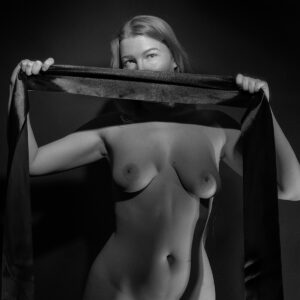
The band became its central symbol. At first, it appears almost protective — something that supports, orders and holds together. Gradually, however, its function changes. It begins to shape the body, to tension it, to regulate visibility and expression, until eventually a force emerges from outside the frame itself: an invisible social pull to which the figure simultaneously submits and resists.
The title Habitus deliberately refers to the way social structures become embedded within the individual. Society is not expressed merely through clothing, language or status, but through stance, movement, tension and bodily presence. Social order does not remain outside the body. It becomes part of it.
Formally, the series translates this tension through a reduced visual language. The light remains hard and directional, the shadows dense and partially impenetrable. The body is never fully available, never entirely readable. Visibility is not granted unconditionally, but rationed.
The individual works describe different states within this social landscape:
I — Ordo
Order as protection and the foundation of coexistence.
II — Forma
The body begins adapting itself to external form.
III — Nexus
Connection, dependency and entanglement become inseparable.
IV — Silentium
Visibility and expression come under control.
V — Trahere
An invisible force begins pulling from beyond the frame.
Habitus does not understand the human body as an object, but as a surface upon which social structures leave their inscriptions — long before they are ever spoken aloud.