
Licet
It is permitted.
Few phrases sound more harmless. Yet behind these simple words lies a question that every society must answer again and again: What may be shown? And perhaps even more importantly: Who decides?
The photographs in this series explore the tension between personal freedom and social expectation. They are not about nudity as provocation, nor about concealment as shame. They are about the power to draw boundaries—and about the question of who those boundaries truly belong to.
Two fans accompany the series. One represents society: its norms, moral standards, expectations, and judgments. It stands for all those forces that often remain invisible, yet still influence how people are expected to be seen. The other fan represents the individual: personal choice, the right to reveal or to withdraw, and the freedom to decide what becomes visible and what remains hidden.
Between these two poles, a silent dialogue unfolds. At times, the voice of society seems stronger. At others, personal choice gains ground. Sometimes the two become almost indistinguishable. Not every boundary is imposed from the outside, and not every act of self-restraint arises from free will.
The body remains visible throughout the series. Yet visibility alone does not imply openness. One may be seen without truly revealing oneself. One may reveal oneself and still remain misunderstood. Visibility and availability are not the same thing. In an age of constant public observation, that distinction is easily forgotten.
The series therefore does not offer answers. Instead, it invites reflection. It asks the viewer to question their own gaze. What expectations do we place upon others? Which images do we accept as natural or self-evident? And which boundaries do we respect—or cross without noticing?
In the end, a simple question remains:
What is visible—and who decided that it may be seen?
Between what is possible and what appears to be permitted lies a narrow space in which freedom is negotiated.
That is where Licet begins.

Tacita Lex
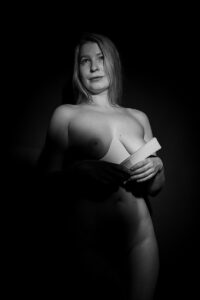
The shadow of society’s fan falls across the body, although the fan itself remains unseen. Its influence is present nonetheless.
Social rules rarely appear openly. Most often, they present themselves as self-evident truths. They do not need to declare what is permitted and what is forbidden. Their presence alone is usually enough.
The personal fan remains closed. The possibility of choice exists, but it has not yet been exercised.
Perhaps this image marks the beginning of the story. Or perhaps it depicts a condition in which we find ourselves far more often than we realize.
Regula
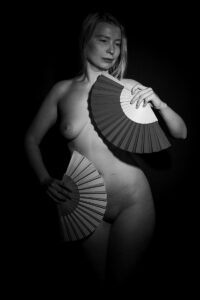
Two fans shape the image. One conceals, the other directs the gaze.
Rules provide orientation. They can protect, but they can also restrict. Often they become so deeply embedded within us that we no longer recognize them as rules at all.
The eye moves back and forth between the two fans. What is hidden appears just as significant as what remains visible.
Perhaps the image speaks about social expectations. Or perhaps it reveals the rules we have long since adopted as our own.
Abscondita
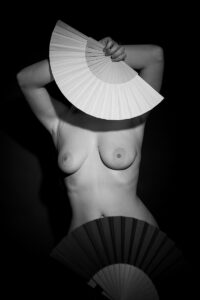
The body remains visible, while the face disappears completely behind the fan.
For many people, the face is the primary place of identity. Without it, the person becomes harder to grasp. The body remains, yet individuality withdraws.
A curious tension emerges. On one hand, more appears to be revealed than before. On the other, what feels most essential remains concealed.
The question remains open: is something being hidden, or is it being deliberately protected from the gaze of others?
Interrogo
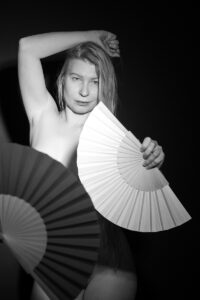
For the first time, the model’s gaze meets that of the viewer directly.
The roles begin to shift. Who is observing whom? Who asks the questions? And who is expected to answer them?
Both fans remain present, yet they seem less like barriers than before. They resemble instruments through which visibility itself is negotiated.
The image offers no answer. Instead, it returns the question.
Interposita
The figure stands between the two fans. Neither the voice of society nor personal choice appears to dominate completely.
The image feels like a moment of suspension—a state between conformity and freedom, between expectation and self-determination.
Many of the decisions we make in life emerge precisely within such spaces. Not as clear acts of obedience, nor as open rebellion.
Perhaps that is why the image does not depict conflict. Instead, it portrays a condition familiar to almost everyone.
Quies
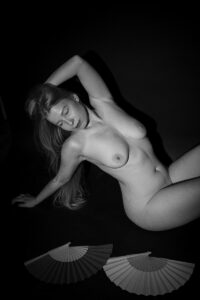
The fans lie on the ground. The negotiation appears to be over.
What was previously contested between visibility and concealment has lost its urgency. What remains is stillness.
Whether this stillness signifies liberation or exhaustion is left unresolved. Equally uncertain is whether the fans have been discarded or have simply become unnecessary.
Perhaps this is the end of the story.
Or perhaps it is where the story truly begins.