
Manus Liberae — free hands — explores the hand as a tool, a sign and an acting force. Hands write, call, refuse, seek, hold, touch, command, cover, bind and bear witness. They create expression, protect and liberate, but they can also restrict, conceal and exercise power.
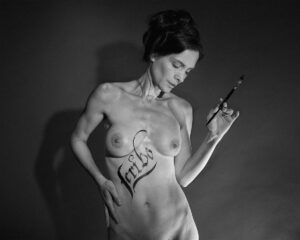
Latin verbs in the first person are written across the body of the woman depicted. The historical Bastarda script deliberately contrasts with the immediate presence of the body. Word and gesture do not fully explain one another: the verb suggests a direction, while posture, gaze and hands expand, confirm or question its meaning.
The unclothed body does not appear as a costume of seduction, but as an undisguised bearer of language and action. It assumes no role beyond the one created by the respective verb and physical gesture. Light and shadow remove the figure from ordinary space and condense each photograph into a single statement: I act.
01 — SCRIBO
I write
The hand guides the brush, yet the writing appears on the body itself. Writing therefore becomes more than the recording of a thought: it is an action that leaves a visible trace. The body is simultaneously writing surface, work and author of its own statement.
02 — VOCO
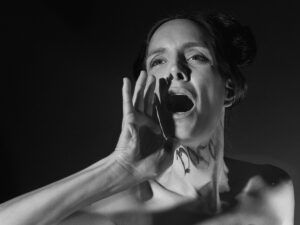
I call
The hand forms a funnel in front of the open mouth and amplifies the voice. The call is directed outward, yet no audible answer exists within the image. A moment of tension emerges between communication, demand and cry for help.
03 — NEGO
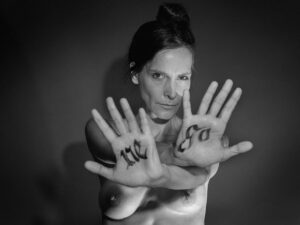
I deny · I refuse
Both hands confront the viewer. Refusal is not presented as a passive absence of consent, but as a visible and physical action. The direct gaze leaves no doubt as to who determines the boundary.
04 — PETO
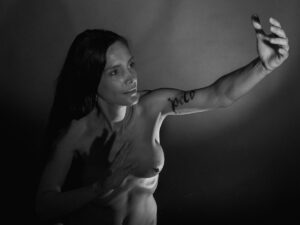
I seek · I strive for · I demand
The hand reaches into space, as though the object of desire lay just beyond its grasp. Peto does not mean only to seek, but also to strive and to demand with resolve. The gesture therefore remains open between hope, desire and claim.
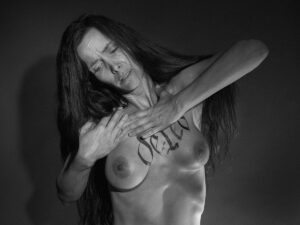
05 — DELEO
I erase · I undo
The hands conceal, blur and press against the written statement. Yet even what has been erased does not disappear without a trace: remnants remain on the skin and in memory. The image asks whether an action can ever truly be undone.
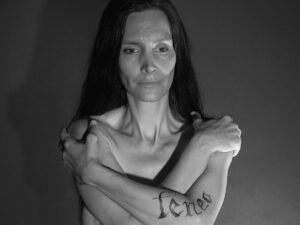
06 — TENEO
I hold · I hold fast
The arms enclose the body. Holding may signify protection and preservation, but it may equally imply clinging and the inability to let go. The gesture remains deliberately suspended between self-care and self-limitation.
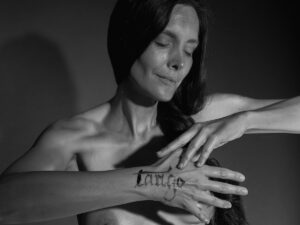
07 — TANGO
I touch
Touch is the quietest action in the series. The hands establish contact without grasping or claiming possession. The closed gaze turns perception inward and transforms touch into a form of self-assurance.
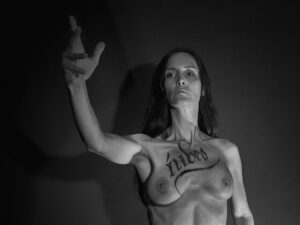
08 — IUBEO
I command
The raised arm and upright posture lend the figure authority. The command is legitimised by no external insignia, but solely by body, gaze and gesture. Power appears here as an assertion created at the very moment of its expression.
09 — TEGO
I cover · I protect
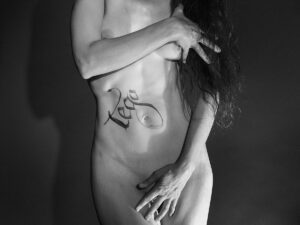
The hands withdraw parts of the body from view. Covering may offer protection, but it may also conceal, withhold or deny access. The person depicted determines what remains visible and what is hidden.
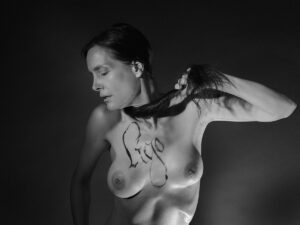
10 — LIGO
I bind · I restrain
The figure’s own hair becomes a band around her neck. The hand is at once the force that binds and the one that suffers under that binding. The image therefore presents a contradiction between self-determination, compulsion and participation in one’s own restriction.
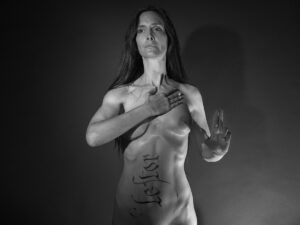
11 — TESTOR
I bear witness · I declare solemnly
The hand placed upon the chest and the raised oath-taking hand unite personal conviction with public declaration. The testimony is directed not only toward others, but also binds the speaker herself. As the final image, the individual action becomes a profession: what has been said and done is borne witness to.d.