
How tools change – while artistic working methods survive for centuries
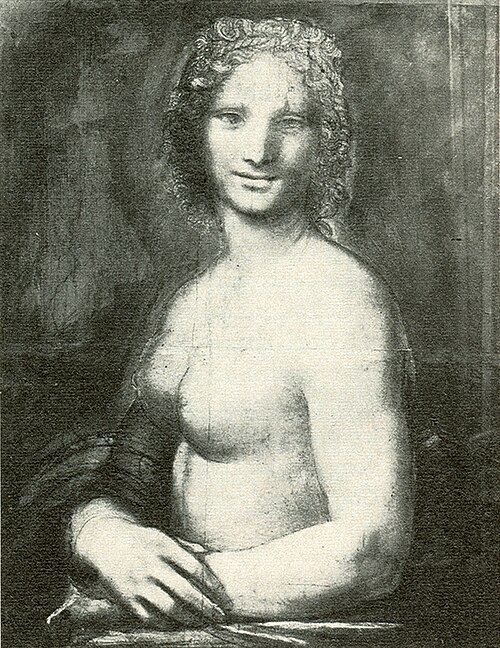
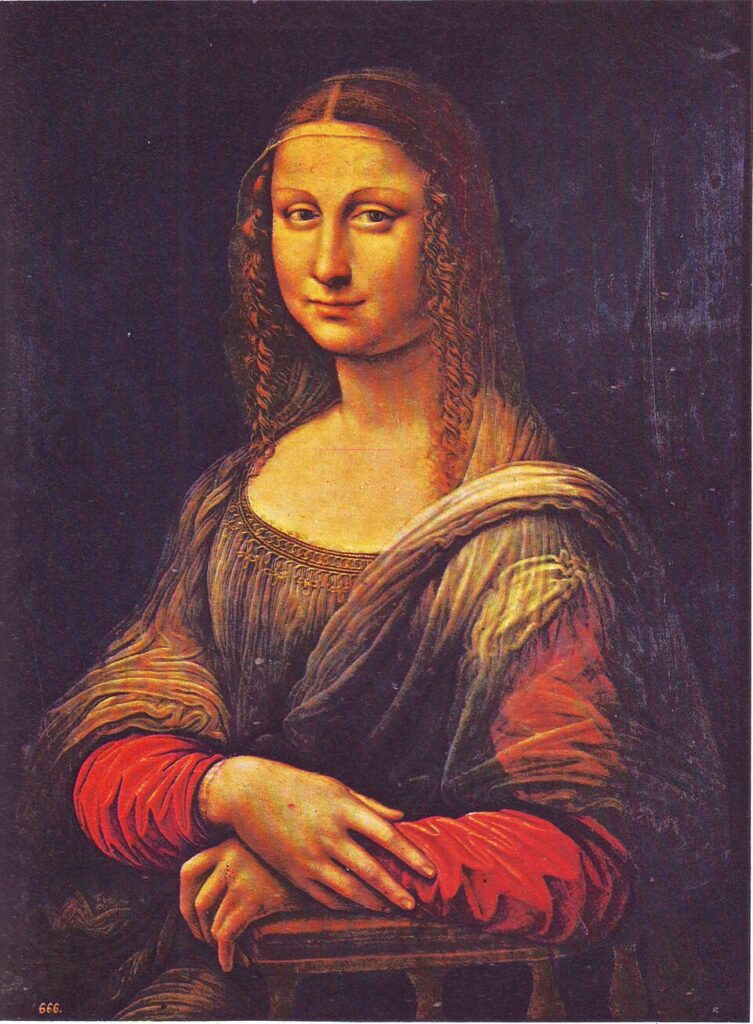
There are works of art we believe we know. The Mona Lisa undoubtedly belongs among them. You do not even need to have seen her in the Louvre. Dark dress, folded hands, landscape in the background, and that smile about which generations have written more than Leonardo da Vinci himself would probably have been willing to endure. The Mona Lisa ceased to be merely a painting long ago; she has become part of our cultural inventory. Which makes it all the more disconcerting when one suddenly encounters a woman in almost the same pose, with the same hands and the same direct gaze – only without the dress.
She is known as the Joconde nue or Monna Vanna and is now held by the Musée Condé in Chantilly. She is not some frivolous parody produced centuries later, but a large-scale drawing from Leonardo da Vinci’s immediate circle, made in the early sixteenth century. The extent of Leonardo’s own involvement has not been conclusively established. Scholarship is, fortunately, somewhat more cautious about attribution than the internet, which is why “Leonardo’s Nude Mona Lisa” makes an excellent headline but a rather less satisfactory art-historical statement.
It is reassuring, at least, to discover that some five hundred years ago somebody had already arrived at the idea that an unclothed human body might conceivably be a suitable subject for art. Apparently, word has still not reached everyone. I am repeatedly criticised because the models in my work are nude. By now I find this less outrageous than remarkable. Nudity in my work rarely interests me as nudity. An unclothed body is first and foremost form: line, surface, tension, posture, skin and shadow. Clothing immediately introduces another story. It reveals period, fashion, social role and sometimes status. That may be necessary for an image. It may also be precisely the information the image does not need.
Perhaps it was inevitable, then, that the Mona Lisa’s naked relative initially caught my attention because of her nudity. That particular aspect of the fascination did not last very long. The more closely I looked at the drawing, the more interesting a number of tiny holes in the paper became. They lead us to an old transfer technique known as spolvero, or pouncing. An elaborate drawing – often a full-scale cartoon corresponding to the intended work – was perforated along its essential lines. The cartoon was then placed on the new surface and charcoal or pigment dust was applied through the holes. Once the cartoon was removed, a dotted version of the contours remained beneath it. The drawing was therefore not merely a drawing; it could serve as the working basis for another execution of the composition.
And this is precisely where an attractive art-historical curiosity becomes something considerably more interesting. Such a cartoon could represent an intermediate stage between an idea and the executed work. Once developed, a composition could be transferred, reused and further developed. The visual idea did not have to be invented again from scratch every time it was executed. Which makes those tiny perforations in the Joconde nue more interesting than her naked breast. Art-historically, at least. I would not dare make the same claim about the mechanisms of the internet.
We look at the Mona Lisa today behind protective glass in the Louvre and inevitably think backwards from the finished masterpiece. There hangs the original. Therefore, anything that looks similar must somehow have come afterwards. Master paints masterpiece, pupil copies masterpiece. Finished. Art history can be wonderfully tidy, provided nobody starts looking too closely. Unfortunately, somebody did.
The Mona Lisa in the Museo Nacional del Prado is particularly interesting in this respect. For a long time, it could conveniently be regarded simply as a copy. Technical examination, especially infrared reflectography, revealed something rather more peculiar. Beneath the visible paint layers lie the preparatory drawings of the two paintings, and within them it is possible to trace changes made during the process of creation. Leonardo altered, among other things, the outline of the waist and bust, the position of the fingers, the veil and the contour of the head; smaller adjustments concern the cheek and neck. Corresponding changes can also be found beneath the surface of the Prado version. More remarkably still, its painter included elements in the underdrawing that Leonardo had initially drawn but subsequently did not carry through to the visible surface of the Louvre painting.
That is fairly compelling evidence. An ordinary later copyist can copy only what is visible. If Leonardo initially draws a line, later abandons it and leaves no trace of it on the finished surface, somebody sitting in front of the completed painting years later cannot know about that discarded idea. If it nevertheless appears in the underdrawing of a second painting, things become interesting. On the basis of these findings, the Prado concludes that the two painters worked in parallel and that the painter of the Prado version directly followed a substantial part of Leonardo’s creative process. The figures are also identical in size and shape and, according to the Prado, were probably transferred from the same cartoon.
Suddenly, then, we are no longer simply standing before an original and its copy. We are looking at two material manifestations of a visual idea while that idea was still developing. This does not mean that the two paintings are of equal art-historical status, nor that the distinction between Leonardo and his assistant becomes meaningless. It merely means that our convenient model – first the finished original is created, then somebody copies it – does not work here.
The Museo Nacional del Prado devoted an entire exhibition to precisely this problem in 2021–22: Leonardo and the Copy of the Mona Lisa. New Approaches to the Artist’s Studio Practices. What is particularly interesting is the range of questions the museum placed at its centre: the importance of the idea, the concept of the original, and the functions and different types of copies that could emerge within a Renaissance workshop. The Prado does not describe Leonardo’s relationship with his assistants as a simple production line for Leonardo imitations. As long as their work corresponded to his conception of art, he passed ideas on to pupils and allowed them to explore different pictorial solutions. Some surviving workshop paintings therefore preserve intermediate stages in Leonardo’s own development of a composition.
By this point, the whole affair had begun to feel suspiciously familiar.
When I prepare a photographic work, it does not normally begin with the camera. The image exists beforehand. Not completely, and certainly not determined down to the last shadow, but as an idea. I know its underlying tension, approximately how the body should be positioned, perhaps already the direction of a shadow, a piece of writing or a particular object. During the shoot, this idea produces variants. I may make five or six different photographs of a single setup. Not five or six because the shutter release has already been paid for, but because an idea can only truly be judged once it exists in front of the camera.
A hand moves ten centimetres higher and suddenly the entire line of the body works. The head turns slightly and the expression changes. An edge of shadow that worked magnificently in my imagination looks simply wrong in reality. And sometimes something appears almost incidentally that was never planned at all, yet carries the original idea better than the carefully prepared version. Afterwards, I do not necessarily choose the most beautiful photograph. I choose the image that carries my idea most strongly – or the one that has developed it further.
This does not, of course, mean that I “work like Leonardo”. That qualification seems advisable for reasons of art-historical hygiene. My studio contains neither Renaissance apprentices nor anyone willing to do my Photoshop work while I gaze meaningfully out of the window. Regrettably. What interests me is something else: the tools have changed. The working method, surprisingly little.
There, paper, charcoal, needle and pigment dust; here, camera, sensor, RAW file, screen, layers and masks. Between them lie five hundred years, the invention of photography, industrial image production and eventually digitalisation. Technically, these worlds have very little in common. And yet between an idea and a finished work there remains a remarkably familiar space. An idea acquires an initial form; that form is tested; possibilities emerge; some work and others do not. Decisions are retained, rejected, altered or transferred into the next stage of the process. Only eventually does one of these possibilities become the single image the viewer will later encounter.
Spolvero and a Photoshop mask are obviously not technically the same thing. It would be rather strained to turn a perforated drawing dusted with pigment into a precursor of Photoshop. But both encounter a much older artistic problem: how do I carry an already established visual decision into the next stage of a work? What should remain, what may be changed, and which of the possible solutions best carries the original idea?
Perhaps this is one of the reasons I engage with art history. Not because I want to recreate old techniques as faithfully as possible, nor because art was somehow more “correct” in the past. Artistic work does not emerge in a vacuum. We are shaped by images, forms and ideas that existed long before us. Studying their history allows us to begin understanding why something appears harmonious, tense, overloaded or empty – and to feed that understanding back into our own work. Occasionally, one discovers something else in the process: it is not only our ways of seeing that have a history. Our ways of working have one too.
Materials come and go. Wooden panel, canvas, photographic plate, film and sensor belong to different technological worlds. Tools disappear and others are invented. What once required a needle, a cartoon and pigment dust can today be accomplished, in another form, with a file and a few operations. Yet the fundamental problem stubbornly remains: an image in the mind is not yet an image. It has to become visible. And along the way, possibilities are tested, compared, altered, rejected and selected.
Perhaps, then, our almost obsessive question of which work is “the original” is sometimes less interesting than asking how an idea became a work in the first place. The Joconde nue initially interested me because one of the most famous women in art history was suddenly sitting before us without her clothes. By the end of her story, I find her nudity the least remarkable thing about her.
That is almost a pity. After all, an unclothed body still attracts attention more reliably than a few tiny holes in a five-hundred-year-old sheet of paper. My own experience confirms this quite adequately. One can talk about composition, the placement of shadows, the lines of the body or the cultural history of writing – and sometimes the only insight that remains with the viewer is:
The woman isn’t wearing anything.
The Joconde nue, at least, left us a few holes in the paper as well. And they tell the more interesting story.
Would you like the English version to sound more literary and essayistic, or more concise and magazine-like?