
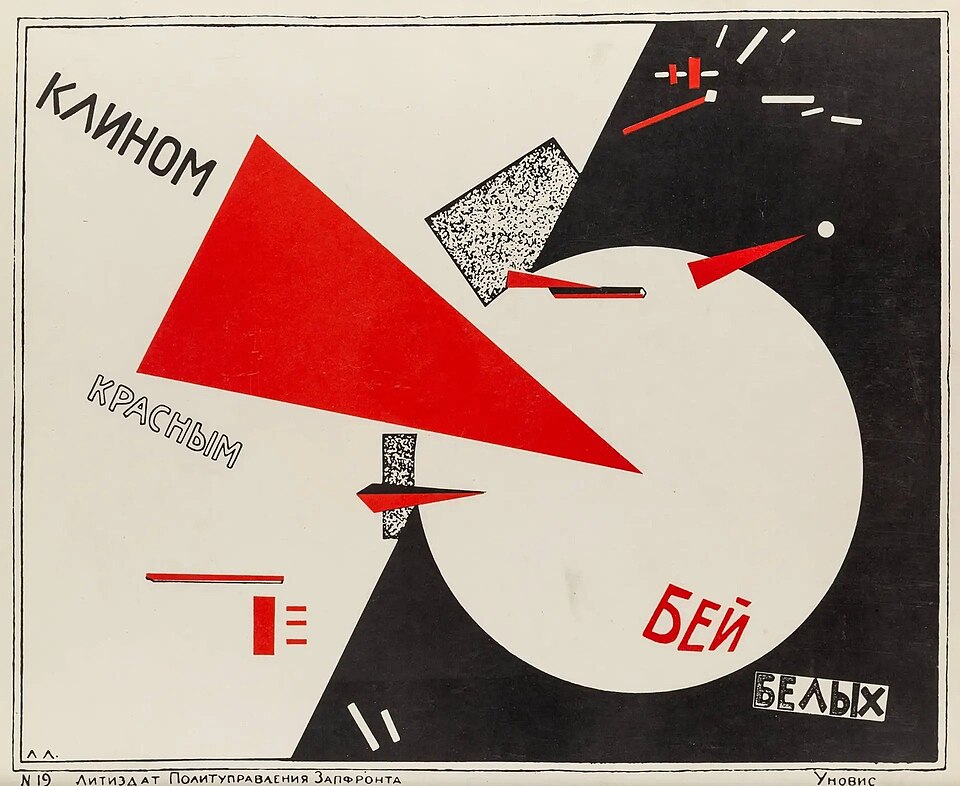
On geometric order, social utopias, and what photography can learn from an art movement more than a century old.
Reality Is Not a Composition
A staircase is, first and foremost, a staircase. It connects two levels and has steps, railings, and a particular spatial structure. Yet in a photograph, that same staircase can become something entirely different: a sequence of rhythmic lines, an ascending diagonal, an interplay of light and dark surfaces. Its original function recedes into the background. What remains is a geometric order.
Something similar happens when a photographer captures a building façade in such a way that windows, architectural edges, and shadows form an abstract composition. Or when someone arranges French fries not on a plate, but into a precise pattern according to their length, shape, and direction. The objects remain the same, yet their relationships change fundamentally. This is one of photography’s remarkable possibilities: it need not merely depict reality, but can create a pictorial reality from existing or deliberately arranged elements—a reality that does not exist in quite that form outside the image.
The question of how such an order comes into being leads us to Constructivism, an art movement that, more than a century ago, sought not only to create new images but, for a time, to help shape a new society. Its political ambitions belong to a particular historical era. Its artistic insights, however, remain relevant today. Not every photographer who discovers a diagonal is therefore a Constructivist. Otherwise, we might have to grant the inventor of the window frame honorary membership in the movement.
Art for a New Society
Russian Constructivism began to develop around 1915 and gained increasing importance after the October Revolution of 1917. Artists such as Vladimir Tatlin, Alexander Rodchenko, Lyubov Popova, and El Lissitzky were concerned not merely with geometric forms, but with a fundamental question: What role should art play in a new society?
Many sought to overcome the traditional separation between artist and producer. Art should no longer exist primarily as a unique object for wealthy collectors, but should become part of the design of everyday life. Furniture, clothing, posters, books, buildings, and industrial products became potential fields of activity. Artistic construction was intended to produce not only new images, but an entirely new material environment.
This attitude was closely connected to the revolutionary social ideas of the period, although the artists involved did not all share identical political or aesthetic positions. The Productivist tendency, in particular, questioned traditional easel painting. The artist was no longer expected merely to produce pictures, but to participate actively in shaping social reality. This distinguished historical Constructivism fundamentally from a simple enthusiasm for geometric forms. Diagonals, circles, planes, and rhythmic repetitions were connected to new ideas about labour, technology, production, and social organisation.
History, however, took a remarkable turn. The very revolutionary avant-garde that had hoped to contribute to society’s cultural renewal came under increasing pressure from a political system that progressively restricted artistic experimentation. With the reorganisation of Soviet cultural life from 1932 onwards and the subsequent establishment of Socialist Realism as the official artistic doctrine, Constructivism largely lost its foundation as an independent avant-garde movement within the Soviet Union.
Its visual language survived. Through international contacts, graphic design, architecture, photography, and institutions such as the Bauhaus, Constructivist ideas continued to exert an influence far beyond the Soviet Union. Today, we frequently encounter geometric compositions in an entirely different context: they appear in expensive art books, are exhibited in galleries, or are sold as limited-edition works. A movement that had, in part, sought to overcome traditional art production has thus found its way into the very institutions from which it once wished to distance itself. History evidently possesses a certain sense of irony.
Geometry Does Not Automatically Mean Constructivism
Geometric forms were, of course, not invented by the Russian avant-garde. Symmetry, proportion, and the organisation of pictorial space had occupied artists for thousands of years. At the beginning of the twentieth century, however, several artistic movements emerged that gave these forms new meanings and, despite superficial similarities, sometimes pursued fundamentally different aims.
Cubism, shaped particularly by Pablo Picasso and Georges Braque, broke down the familiar appearance of objects and combined different viewpoints within a single image. Suprematism, founded by Kazimir Malevich, went further, seeking a non-representational art in which simple geometric forms became expressions of pure feeling. The Dutch movement De Stijl, whose leading figures included Piet Mondrian and Theo van Doesburg, sought a universal pictorial order. In Mondrian’s work especially, horizontal and vertical lines and the primary colours predominated.
The Bauhaus, meanwhile, was less a unified artistic style than a school and a comprehensive programme of design. It brought together art, craftsmanship, architecture, and technology, incorporating Constructivist ideas along the way. László Moholy-Nagy, in particular, applied experimental approaches to light, space, and construction to photography. New Objectivity, by contrast, emphasised the precise depiction of objects, materials, and structures. Photographers such as Albert Renger-Patzsch and Karl Blossfeldt revealed the formal order already present in industrial products and natural forms.
Concrete Art, formulated later, regarded lines, colours, and planes not as abstracted representations of another reality, but as independent visual elements. Minimalism, Op Art, and Conceptual Art also took up some of these questions during the twentieth century, although each developed different priorities. These movements deserve closer examination, and I intend to return to them in future essays. For our present purposes, one distinction is essential: historical Constructivism was a particular art movement with its own social and aesthetic convictions. The deliberate construction of an image, on the other hand, is a general artistic method, confined neither to that period nor to its political aims.
My Son Could Do That Too
Few artistic movements are quite so effective at strengthening the casual art viewer’s confidence as geometric abstraction. A black square on a white background? My son could do that. A few coloured rectangles? Apparently, one would not even need a particularly gifted son. And when someone arranges ordinary objects at regular intervals, one might reasonably suspect that a person simply stopped tidying up at precisely the right moment.
The objection is understandable. After all, we often judge craftsmanship by how difficult its execution appears. A convincingly realistic portrait clearly requires considerable skill. Painting a black square, by comparison, presents relatively modest technical challenges. Yet the difficulty of execution does not answer the question of artistic significance.
Kazimir Malevich’s Black Square of 1915 is not historically important because painting a black surface was particularly difficult. Its significance lies in the radical consistency with which Malevich abandoned representational depiction and proposed a new conception of the image. The work belongs to a specific historical and theoretical context that cannot simply be reproduced by imitating its appearance.
A child could certainly paint a black square. A child might also accidentally play a sequence of notes identical to a familiar melody. That would not mean the child had composed the melody, nor would it render the original composer’s achievement meaningless. Nevertheless, the argument should not be turned completely on its head. Not every arbitrary geometric arrangement becomes a significant artwork merely because its creator provides an elaborate explanation. A black square is not automatically profound. Sometimes it really is just a black square. The distinction lies not in visible form alone, but in the artistic decision, its context, its consistency, and its effect.
The Camera Constructs the View
Alexander Rodchenko was among the photographers who fundamentally changed our understanding of photographic composition. He did not regard the camera merely as an instrument for reproducing visible reality as faithfully as possible. For him, it was a tool with which familiar ways of seeing could be disrupted.
His extreme high and low viewpoints, unusual cropping, and dynamic diagonals transformed the character of everyday subjects. A staircase became a sequence of rhythmic forms, a façade a geometric structure. Even people could become elements within a larger compositional order. What mattered was not simply the unusual perspective, but the recognition that the camera’s position fundamentally changes the relationships between objects. Architecture that appears familiar at eye level can become an almost abstract composition of planes when viewed from above.
An interesting shift occurs here: the subject remains present, but loses its unquestioned priority. The focus is no longer the building as a building, but the order created through its photographic representation. For photographers, this offers a simple yet far-reaching insight: one need not always search for an extraordinary subject. It may be enough to discover new relationships within an ordinary one.
What Photographers Can Learn from It
Geometric order is not some secret knowledge that became available only with Constructivism. Nevertheless, its practitioners demonstrated how consistently image-making itself could become the subject of artistic investigation.
A diagonal can create direction and tension. While horizontal lines often suggest calm and vertical lines stability, a diagonal can imply movement or instability. Its effect, however, depends on the composition as a whole. Tilting a camera does not automatically produce an interesting photograph, although some competition entries occasionally seem determined to suggest otherwise.
Rhythm emerges through repetition. Rows of windows, stair treads, columns, or strips of light form visual sequences that our eyes recognise as belonging together. A disruption can be particularly interesting: a single open window in an otherwise closed façade, or a different shape within a regular sequence. The relationship between figure and ground, in turn, determines what we perceive as the subject and what we regard as its surroundings. The bright space between two buildings can become the dominant form, while the buildings themselves serve merely as its dark boundaries.
Visual weight also plays an important role. A small, very bright area can balance a much larger dark area without making the composition feel unbalanced. Size alone does not determine the importance of an element. Contrast, position, shape, and relationships with other elements influence our attention. Cropping also turns the edge of the frame into an active compositional tool. A line that seems to continue beyond the image suggests a larger order of which we see only a fragment.
Finally, overlapping can transform spatial relationships. Three-dimensional objects can appear as flat patterns, lines can intersect, and shapes can seem to merge. Spatial depth can be emphasised or deliberately suppressed.
This suggests an interesting exercise for photographic practice: first consider a subject not as a building, body, object, or landscape, but solely as an arrangement of lines, planes, brightness values, and spaces between forms. Only then decide what significance the recognisable subject should have within that order. The aim is not to force the world into geometric patterns, but to develop an additional way of seeing.
The Geometric Aesthetic of Competition Photography
Anyone who follows international photography competitions regularly encounters images that make use of such compositional devices. This is particularly evident in architectural photography. Monumental staircases, rigorously structured façades, unusual perspectives, sharply defined shadows, and black-and-white photographs reduced to a few tonal values have become familiar elements of the visual repertoire. Architecture is often abstracted to such an extent that the original building is barely recognisable.
Such images frequently have an immediate visual impact. A clear geometric order can be grasped quickly. Strong contrasts attract attention, repetitions create rhythm, and unusual perspectives arouse interest. In competitions where jurors must assess large numbers of photographs, this immediate legibility may be an advantage. That does not, however, provide a universal explanation for competition success. Different juries apply different criteria, and a visually striking photograph is not necessarily an artistically convincing one.
This is where the question becomes interesting to me. If a photographer shoots a staircase from below, converts the image to black and white, increases the contrast, and darkens the sky almost completely, the result may be an impressive composition. Yet when hundreds of photographers employ the same techniques, the supposedly unusual viewpoint eventually loses its originality. What began as a liberation from habitual ways of seeing can itself become a convention.
A photograph can be technically flawless, formally balanced, and still lack substance. It may demonstrate above all its creator’s ability to apply familiar compositional techniques with confidence. That deserves recognition as craftsmanship, but craftsmanship and art are not identical.
When French Fries Become Lines
A particularly vivid contemporary example of geometric design principles can be found in the work of Adam Hillman. He arranges food and everyday objects into precise patterns. French fries become parallel lines, sweets become rhythmic fields of colour, and fruit and vegetables become geometric structures. Size, shape, colour, and repetition determine the composition.
Unlike Rodchenko, who reinterpreted existing spatial relationships through the camera’s viewpoint, Hillman often creates the order before taking the photograph. He changes not only how an object is seen, but its actual arrangement. The photograph then records a deliberately constructed reality.
This reveals an interesting parallel with constructive artistic thinking. Objects are used not primarily for their original function, but for their formal properties. A French fry becomes interesting as an elongated element, a sweet as a coloured circle, a piece of fruit as a plane or volume. Yet their origins remain recognisable. We still see food. The image therefore occupies a space between recognisable subject matter and geometric abstraction.
Hillman is, of course, not a member of the historical Constructivist movement. His work also has affinities with Pop Art, serial design, ornamental art, and contemporary visual culture. That is precisely what makes it an interesting example: it demonstrates how related design principles can be employed independently of a particular historical movement.
Here, too, however, the question of artistic significance arises. Is an exceptionally precise arrangement of everyday objects already art? Or is it, initially at least, a particularly original form of visual entertainment? There is no universally valid answer. Precision of arrangement alone is certainly not sufficient for me as evidence of artistic quality. What matters is what the arrangement makes visible, perceptible, or conceivable.
The Body Between Geometry and Life
One particularly important connection between geometric construction and representational imagery in relation to my own photographic work can be found in František Drtikol. He was not a representative of Russian Constructivism. His work developed partly during the same period, but within a different artistic environment shaped by Symbolism, Art Deco, dance, and photographic modernism.
Drtikol placed the human body in relation to circles, diagonals, shadow planes, and rigorously designed spaces. The body became part of a larger composition without entirely losing its organic individuality. For me, this marks an essential difference from purely geometric abstraction.
A line has no vulnerability, a circle has no biography, and a plane knows neither movement nor transience. The human body, by contrast, carries all these qualities, at least as possible associations. When geometric order encounters a body, two different principles meet: one abstract, calculable, and repeatable; the other organic, individual, and changeable.
A diagonal can extend the line of a body; the edge of a shadow can seemingly divide it. A circle can enclose a figure or give it a new spatial meaning. A strictly symmetrical order can be disturbed by the slightest movement. Yet geometry need not necessarily work against the body. It can also support, reinforce, or integrate it into a larger order. The relationship becomes interesting when the two elements interact in a way that goes beyond mere decoration.
Light as a Constructive Material
In my own photography, light occupies a central position. Yet I do not regard it solely as a means of making a subject visible. Light can itself become form.
With Fresnel spotlights, sharply defined shadows, projections, and geometric areas of light, it is possible to create pictorial spaces that are not simply found in the world. They come into being through photographic staging. An edge of light can perform the same compositional function as the edge of a building, a strip of shadow can form a diagonal, and a projected circle can enclose a figure. A series of narrow areas of light can establish rhythm.
Unlike architectural photography, the geometric order here is not necessarily tied to existing built structures. It can be altered, shifted, overlapped, and created entirely anew. The body enters this order. It can follow it, interrupt it, or transform it through its shape. Light and body thus become equally important elements of the composition.
I am increasingly interested in whether the meaning of an image must be fully determined before it is created. I often develop extensive conceptual frameworks. Historical references, mythological figures, forms of writing, and philosophical ideas can provide the starting point for photographic work. This gives the images an intellectual foundation, but it also carries a risk: the more precisely the intended statement is defined in advance, the more easily photography can become a mere illustration of that statement.
A constructive approach offers another possibility. One can begin by creating an order from a few elements and examining the relationships that emerge. Meaning need not exist exclusively before the exposure; it can also develop during the creative process. Not every photograph needs a story to tell. Some images acquire their meaning through what they make visible.
The Discipline of Reduction
Reduction is one of the most frequently used terms in art. It is usually understood as the removal of unnecessary elements. That is not wrong, but it does not go far enough. A reduced composition does not simply require fewer objects; it demands more precise relationships between those that remain.
Anyone working with just a line, a plane, a body, and a shadow has little opportunity to conceal compositional weaknesses. Every shift changes the relationship between forms, every change in contrast affects visual weight. Every additional strip of light can support or destroy the order. Reduction, therefore, should not be confused with simplicity. The decisive question is not how little an image may contain, but how much can be achieved with a few elements.
Precise order can produce a powerful aesthetic effect. Yet it can also become sterile. If every element follows an entirely predictable rule, there may be nothing left to discover. Conversely, a deviation is not automatically interesting. An intentionally crooked element does not become meaningful merely because it disturbs symmetry. Even the disruption of order can become a compositional routine. What matters is whether the relationships between the elements possess an inner necessity.
When Does Composition Become Art?
This brings us to a question that extends far beyond Constructivism: What distinguishes a perfectly composed photograph from an artistically significant work?
A definitive answer would be presumptuous. Art cannot be defined by a universally valid formula. Nevertheless, I believe it is useful to distinguish between formal quality and artistic significance. Formal quality can, at least to some extent, be described. We can examine how lines run, how planes are weighted, how contrasts operate, and how the viewer’s gaze is directed. We can assess whether a composition appears coherent and whether its visual means have been employed deliberately.
Artistic significance is more difficult to determine. Among other things, it depends on whether a work opens up experiences, questions, perceptions, or thoughts beyond its formal organisation. A photograph need not convey an unambiguous message. On the contrary, an overly predetermined statement can restrict its openness.
An image can be interesting because it changes our habitual perceptions, makes a familiar subject appear strange, or reveals tensions we had not previously noticed. It can also be convincing because its formal order becomes an intense aesthetic experience in itself. That does not mean, however, that every unusual perspective automatically produces a new insight. The novelty of an effect is not a reliable measure of artistic quality.
This distinction seems particularly important to me in contemporary competition photography. A photograph can attract attention within seconds and be forgotten just as quickly. Another may reveal itself only after prolonged contemplation and remain in the memory for precisely that reason. Neither immediate impact nor gradual discovery guarantees quality in itself. But asking whether an image has something to offer beyond its first visual effect seems entirely justified.
The Reality of the Image
At this point, a connection can be made with philosophical Constructivism without equating the two approaches. Epistemological Constructivism examines how people develop their perception and understanding of reality through sensory impressions, experiences, and expectations. Historical artistic Constructivism, by contrast, concerned itself with the deliberate organisation of forms, materials, and spatial relationships. In different ways, both challenge the idea of an entirely neutral representation of reality.
A photograph does not simply show us the world as it exists independently of every observer. It presents a view determined by position, framing, light, timing, and numerous other decisions. Even when it operates in a documentary manner, it remains a constructed representation. Its meaning, moreover, does not arise exclusively from the photographer’s intentions. Viewers bring their own experiences, expectations, and associations.
A circle can appear as a geometric form, but it may also evoke the sun, the moon, perfection, or confinement. A dark area can be read as shadow, emptiness, or threat. Which interpretation suggests itself depends both on the actual composition and on the viewer’s perception. This does not mean that every interpretation is equally convincing. The image itself establishes limits. Its forms, relationships, and visible content are not arbitrary, but within those limits, meaning remains open.
Perhaps this is one of the particular possibilities of artistic photography: it creates a pictorial reality of its own without being able to control completely how that reality will be perceived.
Order and Its Contradiction
What, then, remains of Constructivism for contemporary photography? Not merely a preference for diagonals, circles, geometric planes, or unusual perspectives. These devices have long since become part of the common vocabulary of visual design. What seems more important to me is the recognition that the order of an image need not serve solely to present a subject attractively. That order can itself become the subject of artistic investigation.
Rodchenko transformed the view of the existing world through his perspectives. Adam Hillman creates new visual orders from everyday objects. Drtikol placed the human body in a relationship of tension with geometric forms and shadows. These different approaches cannot be equated, either historically or conceptually. They do, however, demonstrate the many ways in which a pictorial reality can be deliberately constructed.
For my own photography, the challenge is not simply to adopt such possibilities as stylistic devices, but to explore their relationship with the human body. I am interested not only in perfect order, but also in its limits: the moment when an organic form cannot be entirely accommodated within a geometric structure.
A line can be calculated precisely, a circle constructed perfectly, and a shadow placed with great accuracy. The human body, by contrast, remains individual, changeable, and never entirely abstract. Geometry can organise it, emphasise its forms, or seemingly dissolve it. Yet it cannot reduce the body completely to its own laws as long as we still recognise a human being within it.
Perhaps it is precisely this tension that offers a particular possibility for photographic construction. The goal need not always be perfect order. Sometimes the image truly comes into being only where order encounters something that resists it.