
On political language, shifting boundaries and the creation of enemy images
There are open calls whose themes one finds interesting, and there are others that produce the uncomfortable feeling that their subject has long since arrived at one’s own front door. The Berlendis Venice Art Prize 2027, organised by Marignana Arte and Kosmos Contemporary Venice APS, belongs to the latter category for me. Its second edition is entitled Have We Crossed the Threshold? A Journey Beyond Borders, Identities and Languages. The international call invites artists to explore the crossing of boundaries as a physical, cultural, political, inner and symbolic process.
With my photograph ADVERSARIUS / HOSTIS, I am applying in the Contemporary section for inclusion in the exhibition of twenty finalists, which will be held at Spazio Berlendis in Venice from 20 February to 21 March 2027. What drew me to the call was not merely the current wars, movements of refugees or Europe’s increasingly guarded borders. More decisive was my concern about the political direction in which Europe is moving, particularly Germany and Austria. For before borders are visibly reinforced with fences, checkpoints and uniforms, they often arise and begin to shift somewhere else: in our language.
Dear reader, political debate has never been an undertaking for particularly delicate sensibilities. Democracy lives on disagreement, conflicting interests and opponents who contradict one another. A political opponent, however, is not yet an enemy. That person stands on the other side of a debate, but still within the same political order. We may consider an opponent misguided, incompetent or even dangerous while continuing to recognise that, as a citizen, a human being and a political actor, that person belongs to the same society.
This is precisely where my image begins. Two Latin words are written across the model’s body: ADVERSARIUS and HOSTIS. Adversarius means the person standing opposite us: an opponent or antagonist. In Roman usage, hostis came to denote the public enemy – someone who no longer merely disagrees, but is placed outside the shared order. Linguistically, only a short distance separates these two words. Politically, a catastrophe may occur between them.
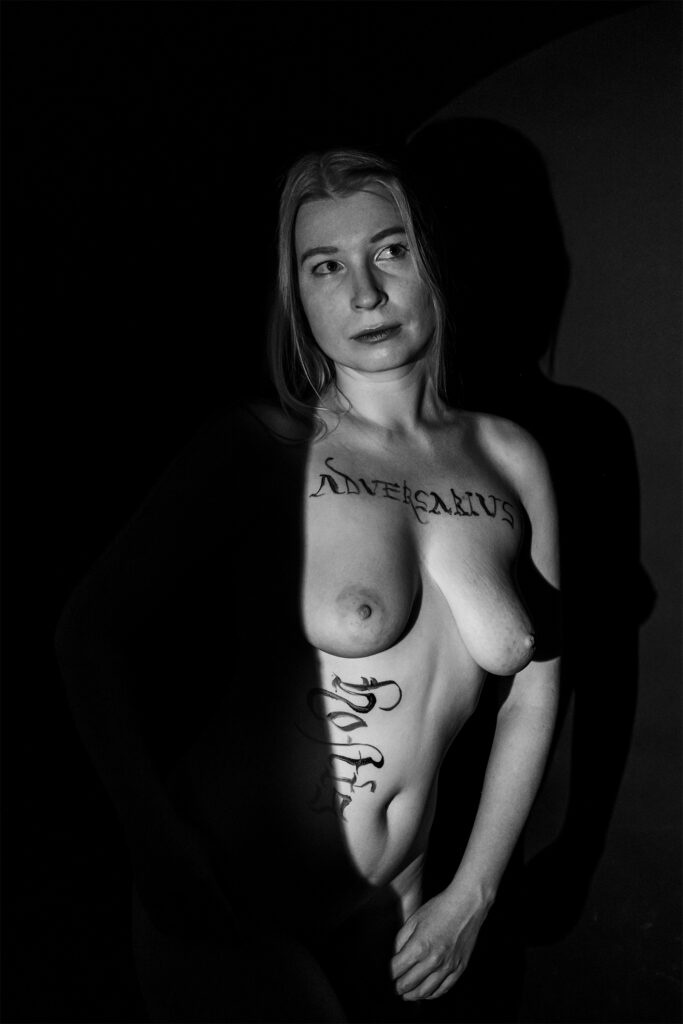
The use of Latin is not a decorative reference to some supposedly more dignified past. It creates distance from the slogans of daily politics and thereby exposes the mechanism behind them. The words appear older than the present conflict because the process itself is ancient: people are named, classified and eventually defined out of a community. Only the labels assigned to the respective groups change. The method itself has demonstrated remarkable historical stamina.
The two words were deliberately written on the body in different historical scripts. ADVERSARIUS appears in Capitalis Rustica, a script of Roman antiquity. In contrast to the solemnly carved Capitalis Monumentalis, it is more flexible and human, yet remains clearly structured, disciplined and comparatively legible. To me, this corresponds to the political opponent: someone who stands against me, perhaps fiercely and irreconcilably, but still within a shared order. The word therefore runs horizontally across the chest and remains largely in the light. It is a designation that has not yet swallowed the human being completely.
HOSTIS, by contrast, appears in Bastarda. This late medieval script combines broken, formal letters with more mobile and sometimes restless cursive forms. Even its historical name refers to its character as a hybrid script that does not belong unequivocally to a single, pure category. Its angular breaks, compressions and abrupt movements make it appear harsher and less stable within the image. The word descends vertically across the body and is partly swallowed by the shadow. It feels less like an objective designation than a mark – almost like a verdict written directly onto the human body.
The juxtaposition of these two scripts is not intended to present a chronological development from antiquity to the Middle Ages. Instead, it makes two different states visible. Capitalis Rustica still grants the adversarius form, order and legibility. Bastarda makes the hostis appear more fractured and threatening. The change of term therefore alters not only what is being said, but also the visible form of what is said. Language does not merely possess meaning. It has a tone, a rhythm and a face – and sometimes that face already reveals what one intends to do with the person being described.
The unclothed body wears no uniform and displays no recognisable social affiliation. It cannot be assigned unequivocally to a nation, a party or a social group. Nudity here does not serve eroticism, but reduction. Clothing would establish age, period, status, origin and social role. What remains is the body as a shared human denominator and, at the same time, as a surface for projection. Upon it appear the words through which political identity can be created and destroyed. The person remains visible, but the act of labelling has already begun to spread across the body.
A sharply defined boundary of light divides the figure. One part remains visible while another almost completely disappears into darkness. This is not a geographical border. It marks the point at which perception changes: from counterpart to stranger, from stranger to threat and from threat to enemy. At the same time, it represents the shifting boundary of what society is prepared to accept. The light does not end by chance. It shows the ever-narrowing area in which another person can still be recognised as an individual before disappearing into a politically manufactured category.
Behind the figure, an enormous shadow rises. It was created during the photographic exposure itself and was not digitally inserted afterwards. The body is not monstrous, nor is its posture aggressive. Only its projection appears threatening. This forms an essential part of the image’s meaning: an enemy image need not resemble the actual person. It is enough for a society to be willing to cast its fears large enough onto the wall. The shadow reveals less about the person depicted than about what others make of her.
This transformation can now be observed almost daily in political language. People fleeing persecution or hardship become “invaders”. Political opponents become “traitors to the people”. Parties that do not conform to one’s own worldview are dismissed as “system parties”, while people with left-wing views are described as “ticks”. One might dismiss this as the customary overheating of political rhetoric. Surely one is still allowed to say something – that remarkably versatile sentence with which people frequently defend not their freedom of speech, but their freedom from responsibility for what they have said.
Such terms do not merely describe reality. They change it. A refugee is a person with a history, an origin, a fear and perhaps a hope. An “invader”, by contrast, belongs to an attacking mass. One may feel compassion for a refugee, argue about admission policies or search for political solutions. Against an invader, one must defend oneself. Likewise, a political opponent is someone whose arguments may be challenged. A “traitor to the people”, however, has supposedly turned against the community itself. Language performs the moral preparation: it turns human beings into categories, categories into threats and threats into enemies.
This mechanism becomes particularly evident in the German expression linke Zecke – “left-wing tick”. It is not merely a crude insult such as “fool” or “liar”. A tick is a parasite. It attaches itself to a body, sucks blood and transmits disease. To call a human being a tick is not merely to deny that person political reason or moral integrity. It removes the person from the human community and transfers them into the realm of vermin. One does not have to debate with a tick. One need not examine its arguments or recognise its rights. Vermin is not persuaded; it is removed, poisoned or crushed. The metaphor rather conveniently supplies its preferred course of action along with the insult.
Herein lies the political seduction of such terms. As long as an opponent faces me as another human being, I must engage with that person. I must explain why I believe them to be wrong and accept the possibility that they may answer me. Once I have declared the opponent a parasite, this tiresome democratic labour becomes unnecessary. A tick has no arguments, only a host. It represents no interests; it merely damages a body. Anyone who linguistically transforms people into vermin not only avoids engaging with their views, but also eases their own conscience regarding whatever may subsequently be done to them or denied to them.
The situation becomes particularly bitter when a politician can rely on parliamentary immunity after making such remarks. That immunity serves a necessary democratic purpose: it is intended to protect the freedom of elected office from politically motivated prosecution. It is not, however, a certificate of moral innocence, nor an official confirmation that every act of dehumanisation uttered under its protection is harmless. A statement may be legally protected and still be democratically devastating. The law protects the political function; it does not also launder the language employed. Even the Austrian administrative apparatus would probably be understaffed for that task.
What shifts in this process is not merely the meaning of individual words. The boundary of what may be said publicly without serious political consequences shifts as well. Terms and statements that twenty years ago would at least have triggered an intense debate about resignation are now repeated, defended and ultimately treated as an ordinary part of the political spectrum. The first transgression produces outrage, the second a television debate and the third an election slogan. Afterwards, we are told that society has simply changed, as though it had rained overnight.
The unsayable does not become socially acceptable from one day to the next. First, it is tested. A term is uttered, the reaction is observed, its meaning is relativised and criticism is dismissed as excessive sensitivity. Soon afterwards, the same word is used again, this time accompanied by the insistence that nobody will dictate what one may say. By the next repetition, it has apparently become part of ordinary political language. The boundary was never officially abolished. It was shifted centimetre by centimetre until hardly anyone could remember where it had originally stood.
This gradual habituation is more dangerous than the individual scandal. A scandal at least makes the crossing of a boundary visible. Habituation causes the boundary itself to disappear. What was indecent yesterday is praised as “courageous” today. What is defended as provocation today may become political policy tomorrow. And while people are still arguing about whether a particular word may be used, that word may already have altered how they think about the human beings it describes.
Germany and Austria possess sufficient historical experience to understand this mechanism. One might therefore assume that a certain caution regarding dehumanising language would form part of their basic political equipment. History, however, appears to be a subject whose examination material may be forgotten with remarkable speed once the examination has been passed. This does not mean carelessly equating the present with the 1930s. Such comparisons usually explain less than they claim. Historical situations do not have to be identical for recurring mechanisms to become recognisable.
Describing social groups as parasites, pests or vermin belongs to the old linguistic toolkit of authoritarian and totalitarian movements. History shows what these metaphors are intended to accomplish: they lower moral inhibitions because vermin appears to require neither responsibility nor compassion nor restraint. People who cease to appear as human beings within language can more easily be excluded from rights, protection and social belonging. History does not repeat itself word for word. Some of its expressions, however, are preserved with a care that any museum might envy.
No single word destroys a democratic society, and not every verbal transgression inevitably leads to violence. Yet when contempt is constantly repeated, it loses its exceptional character. First the tone changes, then perception and finally the range of politically imaginable actions. What a society permits itself to say about particular people influences what it eventually believes may be done to them.
The freedom to say something does not mean that what is said remains without consequence. Nor does it release us from the responsibility of considering what our words do. A democratic society must endure fierce disagreement. It cannot, however, indefinitely depend upon its members recognising one another as legitimate opponents while its political language simultaneously declares them enemies. At some point rhetorical hostility becomes social reality. People no longer speak to one another, but only about “the others” – naturally while remaining in possession of that particular truth which, rather conveniently, requires no reply.
ADVERSARIUS / HOSTIS does not illustrate a single political party and offers no completed political answer. Instead, the image holds the moment in which a boundary is both crossed and displaced. The decisive question is not merely who is declared an enemy. It is also: Who possesses the power to enforce that declaration? Who decides which people may still belong to the shared political space? And how often must a degrading term be repeated before we forget that, not very long ago, it would still have been considered unacceptable?
Perhaps the defence of an open society does not begin at its national borders. Perhaps it begins much earlier – with the refusal to turn a political opponent into an enemy and a human being into a pest. A society that can order its conflicts only through enemy images does not become stronger. It becomes divided, poisoned and eventually incapable of understanding itself as a community.
The boundary between adversarius and hostis is invisible. The boundary of what may be said shifts just as invisibly. That is precisely why we should look closely – and listen carefully.