
Judith is one of those recurring figures in European art history that has fascinated artists for centuries. In painting and sculpture, she is most often depicted at the dramatic climax of the narrative: sword in hand, the severed head as proof of action, the moment charged with moral tension. The figure is traditionally bound to a specific iconographic scene.
This cycle deliberately detaches Judith from that narrative framework. The works do not reconstruct the historical story, nor do they attempt to deconstruct it theoretically. All illustrative elements are removed. Instead of focusing on the act itself, the series concentrates on the inner decision that precedes it. The emphasis shifts from visible action to the state of resolve.
The name “Judith” means “the Jewess.” Originally, it designates less an individual personality than a symbolic figure. In this cycle, Judith does not represent a specific woman, but an over-individual stance. She embodies the capacity to make a decision without external command and to carry it through independently of socially assigned roles. The act is not delegated, not legitimized by authority, not ordered from outside — it originates within the figure herself.
The series does not follow a dramatic narrative progression. Instead, space, light and body gradually condense from image to image. The figure withdraws from any potential role attribution and becomes increasingly reduced to formal presence. What remains at the end is neither heroine nor allegory, but a state — a concentrated image of autonomy.







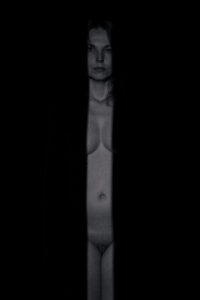
I – Vocatio Interior
The cycle opens not with action, but with an inward call. The figure stands in a state of gathering rather than confrontation. Light divides the body softly, suggesting an emerging awareness rather than a fixed position. This image marks the first moment of internal orientation. Nothing has yet been decided outwardly, but the possibility of decision has entered the space. It is the quiet beginning of autonomy.
II – Conscientia
Here, awareness becomes more explicit. The posture gains clarity, the gaze steadies. The figure is no longer undefined within the darkness; she begins to occupy it deliberately. Light shapes the body more distinctly, separating it from the surrounding space. The image does not depict courage in a heroic sense, but recognition. A decision is forming — not impulsively, but through consciousness.
III – Separatio
This phase introduces separation. The body turns slightly away, establishing distance from implied expectations. The gesture suggests protection, yet it is not defensive. It is an act of self-definition. The contrast between illuminated skin and surrounding shadow becomes sharper. The figure withdraws from assigned roles and begins to stand on her own terms.
IV – Intentio
Concentration intensifies. The composition tightens, and the presence of the body becomes more deliberate. The figure no longer appears as an object of observation but as the subject of intention. The tension lies not in movement, but in stillness charged with direction. The decision has crossed from reflection into resolve. It is now irreversible.
V – Silentium
Silence defines this image. The pose is restrained, almost closed, yet not uncertain. Light is reduced to a minimal articulation of form. The figure does not seek affirmation from outside. This is the moment of complete inward certainty. The decision no longer requires justification. It simply exists.
VI – Transitus
A threshold is crossed. The body moves from contemplation into consequence. The spatial tension increases, and the figure stands more distinctly against the background. There is no dramatization of action — only the clarity of having stepped beyond hesitation. This is not spectacle; it is transition. The autonomy established inwardly now enters reality.
VII – Custodia
The body forms a contained shape, almost circular in its structure. This containment is not retreat but preservation. The figure safeguards her decision from external interference. Light emphasizes this enclosed stability. Autonomy here appears as self-possession rather than confrontation. The energy is held, not displayed.
VIII – Axis
A vertical structure divides the frame, introducing a formal axis. The figure stands aligned with it, centered between shadow and illumination. This is the image of alignment. No narrative remains, no symbolic attribute is needed. The body becomes an emblem of stance. The decision is no longer debated; it is embodied.
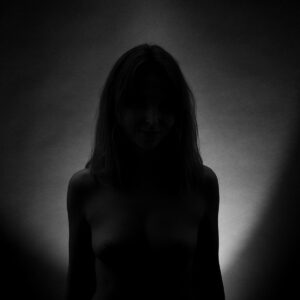
IX – Umbra Decisa
The cycle concludes in radical reduction. The figure appears almost as silhouette, the light positioned behind rather than upon her. There is no visible act, no sign of triumph. What remains is presence shaped by consequence. The decision has taken place, yet it refuses illustration. The final image does not narrate an event — it reveals a state of irreversible autonomy.