The origin of this series goes back to a very specific moment.
Several years ago, I was standing near the Marmore Waterfalls in Umbria. Above me, on the balustrade, a young woman positioned herself to take a selfie. From where I stood below, I did not see the smile that would eventually appear in the photograph. What I saw instead was a strained grimace – a face twisted into an expression designed for the camera. For a brief moment, an image of happiness was being manufactured.
That moment stayed with me. The idea behind this series has been quietly developing ever since.
We live in a time in which images are no longer merely memories; they have become a form of currency. The self is not only experienced but constantly produced, curated, and displayed. Nowhere is this more evident than in the culture of the selfie.
Bodies are increasingly optimized for the logic of the camera: for the length of an outstretched arm, for the distortion of a wide-angle smartphone lens, for the angle of a screen held at eye level. Cosmetic surgery has begun to adapt to these new visual conditions. Some procedures are designed to alter the nose specifically so it appears more harmonious in selfies – regardless of how it might look in everyday life. The photographic image begins to dictate the form of the body.
At the same time, an entire economy of appearances has emerged. There is now a market for used luxury shopping bags. Influencers photograph themselves carrying these empty bags in order to suggest where they shop and what kind of life they supposedly lead. The image becomes more important than the reality behind it.
The selfie thus turns into a form of staging. Filters, retouching, digital smoothing – the mechanisms are familiar. Time and again, carefully constructed online identities collapse when manipulated images are exposed. Yet the desire for the flawless surface remains.
This series approaches that phenomenon from another direction.
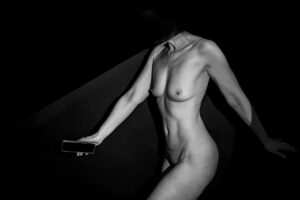
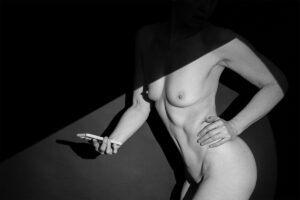
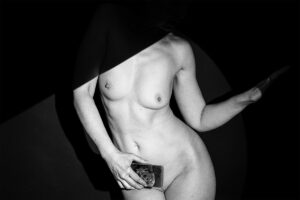
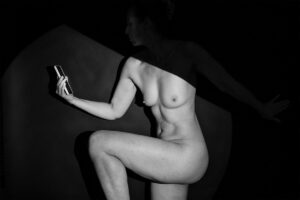
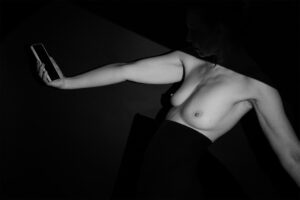
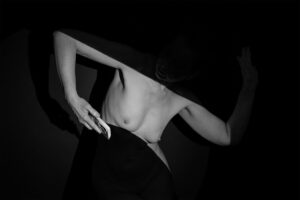
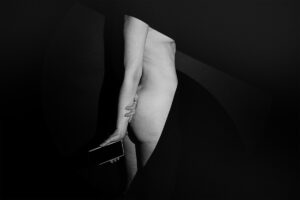
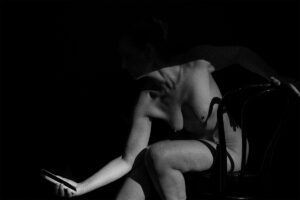
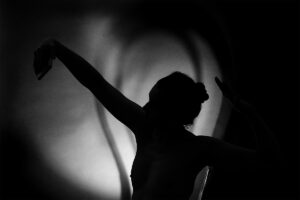
The figures in these photographs reveal themselves while simultaneously withholding their identity. Bodies are visible, but faces remain absent. The individuality normally asserted in a selfie is deliberately removed. What remains is the gesture of presentation itself: a body, a pose, and the device through which the image is produced.
These photographs are not meant to document the selfie. They attempt to expose its underlying logic. The image that claims to represent a self becomes, instead, a silhouette, a projection, a form shaped by light.
What we see is not the person.
What we see is the construction of an image.