
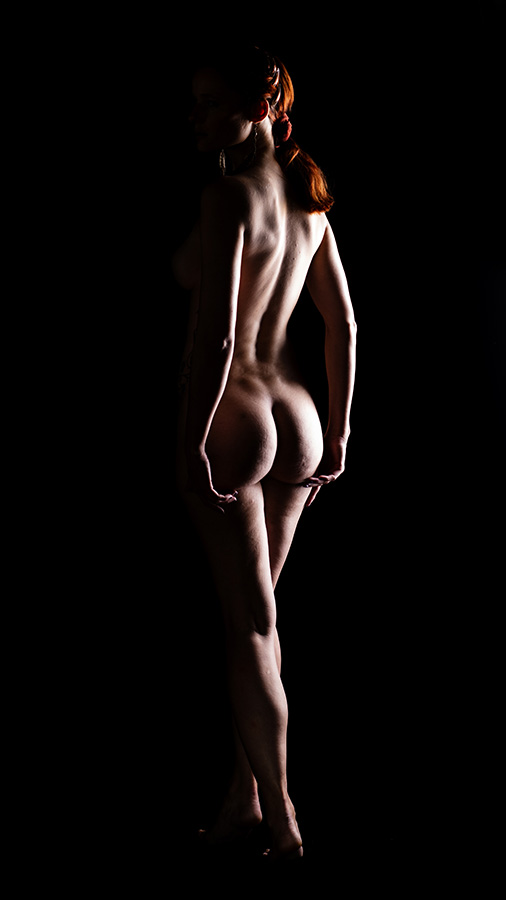
In the first part, I described how the human body can become a landscape. How a back turns into a range of hills, a waist into a valley, and an illuminated hip into a line that emerges from blackness before disappearing into it again. I also explained my rather bold claim that every woman can look good in low-key bodyscape. Now comes the practical question: how are these photographs actually created, and how much work goes into an image that sometimes contains little more than a single illuminated contour?
Anyone imagining an elaborate studio setup with numerous lights, complicated scenery and an entire team of assistants may be disappointed. For most of my bodyscape photographs, I need surprisingly little: a camera, a black background, a suitable light source and, of course, a person in front of it. No antique furniture, no elaborate decorations and certainly no twenty lights competing for attention. Yet this apparent simplicity is deceptive. The fewer elements an image contains, the more precisely the remaining ones must work. When a single line of light carries the entire composition, even the smallest change matters.
The Striplight and Its Rather Unfortunate Name
My preferred tool for these photographs is what photographers call a striplight. Before anyone draws the wrong conclusions from the combination of nude photography and the word “strip”: it is not called a striplight because the model is expected to strip in front of it. It is a long, narrow light source, usually a type of softbox. The light passes through a diffuser, and its elongated shape and positioning make it relatively easy to control. This allows me to emphasise selected areas of the body without necessarily illuminating the entire person. For some photographs, I also use a honeycomb grid to restrict the sideways spread of light.
I frequently position the striplight to the side of the model or slightly behind her. The light then falls primarily on surfaces facing the source. A shoulder acquires a narrow rim of light, the back develops a gentle tonal transition, the waist disappears into blackness and the hip may emerge again further down. What matters is the relationship between the position of the light and the orientation of the body. A very small change in angle can turn a delicate contour into a broad illuminated area or cause a previously visible curve to disappear altogether. The light source alone does not create a bodyscape. It merely provides the possibilities with which I can work.
Why I Prefer Continuous Lighting
For this kind of photography, I particularly enjoy working with continuous lighting. Not because flash is unsuitable, but because continuous light allows me to judge its effect immediately. When I move the striplight, I can see how the illuminated area changes. When the model turns a shoulder or shifts her weight, I can watch a line of light move across her skin, widen or disappear. I do not have to take a photograph first to find out whether a change is moving the image in the right direction. In a visual language where a few centimetres can make all the difference, that is a considerable advantage.
I also use a monitor on which my client can see the photographs as they are created. This changes the nature of our collaboration. If I ask her to move her hip slightly backwards, she can see why that movement matters to the composition. What initially sounds like a rather peculiar instruction suddenly makes sense. Flash certainly has its advantages, particularly when it comes to freezing movement. But for the quiet, precise work involved in shaping bodily contours, I find continuous light particularly useful. In a way, the process resembles a sculptor working with a form that remains constantly visible. Except that my tool is light rather than a chisel, and my material occasionally asks whether she might finally be allowed to stand normally again.
The Decisive Centimetre
The real difficulty of bodyscape rarely lies in the equipment. It lies in the small adjustments. Imagine a woman standing with her back slightly turned towards the camera. A narrow band of light begins at her shoulder, follows the curve of her back, narrows at the waist and finally reaches her hip. Perhaps the line resembles a gently rolling landscape, perhaps an abstract sculpture. Now she turns her upper body slightly. The shoulder becomes brighter, the waist changes shape, the hip becomes more prominent. The composition might improve. Or the very line that held the image together a moment earlier might disappear.
This is when the instructions begin to sound rather absurd to an outside observer: “A little to the left. Stop. Move your shoulder back slightly. No, not that far. Bring your hip forward again. Exactly. Please stay there.” Occasionally, the difference between a successful photograph and an unremarkable one really is a single centimetre. This does not mean that I expect my models to perform complicated acrobatics. Often, shifting weight to the other leg, straightening the back slightly or turning the pelvis a little is enough. Sometimes a relaxed, natural posture is actually the better starting point. Every body responds differently to light, so there is no universal pose that produces the same result with every woman. That would certainly be convenient, but photographically rather boring.
For me, this is one of the essential attractions of the process. I begin with an idea, but I have to be willing to change it while photographing. An unexpected curve, an interesting transition of light or a slight turn of the body can suggest an image I had not originally planned. It requires attention, patience and a willingness to abandon a solution I thought I had already found. Occasionally, it also requires admitting that the position we tried ten minutes ago was actually better.
A Session Begins Long Before the First Photograph
My work with a model does not begin when she enters the studio. Before our appointment, every client receives a questionnaire in which I ask about her ideas, expectations and personal wishes. What kind of photographs would she like? Are there particular parts of her body she would especially like to show? Are there areas she regards as “problem areas”, or parts she would prefer not to see in the images at all? We also discuss personal boundaries in advance. Particularly in artistic body photography, it is important that both parties understand what we want to create and what is expressly not wanted.
These questions also have a photographic purpose. A person’s perception of her own body and my aesthetic judgement can differ considerably. A woman may dislike a particular curve, while I recognise an interesting line that could be beautifully shaped by light. Conversely, a part of her body she finds especially attractive might contribute less to a particular composition. This has nothing to do with attraction in a personal or sexual sense. I am assessing the forms as a photographer: their lines, proportions, surfaces and response to light. Naturally, I can suggest possibilities that my client may not have considered. But my aesthetic judgement never takes precedence over her personal boundaries. If she does not want something shown, it remains outside the frame.
Incidentally, the questionnaire does not deal exclusively with photography. I also ask what my client likes to eat and drink so that I can prepare accordingly. A visit to my studio is not supposed to be an appointment in which poses are completed as efficiently as possible. As I explained in my earlier article “Sensuality Is Not a Question of How Many Buttons Are Undone”, I do not regard these encounters as ordinary photo shoots. I see them as a celebration of my client’s beauty. That includes a personal welcome, something to eat, a drink of her choice and, above all, enough time to settle in. Nobody has to walk through the studio door and immediately take her place in front of a light.
An Enjoyable Afternoon Is Part of the Process
There is a very practical photographic reason for the atmosphere I try to create, quite apart from hospitality. Many people feel uncomfortable in front of a camera at first. They are expected to appear perfectly natural while another person studies them attentively and occasionally gives instructions. With nude photography, the familiar protection of clothing may also be partly or completely absent. It is hardly surprising that this can cause uncertainty. For some people, visiting a photographer probably ranks on their personal list of favourite activities somewhere just behind an appointment with a proctologist.
That is why we take our time. Usually, after about fifty minutes, we have a break, enjoy some of the food I have prepared, have a drink and perhaps look at the photographs together. Depending on my client’s preferences, my hospitality may include a glass of wine or Prosecco, with non-alcoholic alternatives equally available. The planned images and personal boundaries have already been discussed; alcohol is not intended as a way of overcoming inhibitions. These breaks often lead to new ideas. Sometimes a client discovers a photograph on the monitor that particularly appeals to her, or we realise that an unplanned movement has produced a more interesting composition than the pose we originally intended.
A person who feels comfortable moves differently from someone who is tense and trying desperately to get everything right. This affects more than facial expression, which is often invisible in bodyscape anyway. Tension also changes the position of shoulders, back, abdomen and hips. Even a relatively small degree of unease can influence the body’s contours. The more relaxed the collaboration, the easier it becomes to explore different possibilities. I want a woman not only to receive photographs she likes, but also to remember the time we spent creating them as an enjoyable experience. This is not a decorative extra added to the photographic work. It is one of the conditions that help make the work successful.
Why Black Is Not Simply Dark
A common misunderstanding concerns the term low-key itself. Many people initially assume that it simply means a very dark photograph. Yet a dark photograph is not automatically low-key. Otherwise, every picture taken by someone who forgot to switch on the light would have to be declared a work of art. What matters is the deliberate distribution of light and shadow. I do not want to photograph a completely illuminated body and then darken the image on a computer until only a few bright patches remain. I decide during the session which areas should receive light and which may disappear into darkness.
The transitions between light and dark are especially important on the visible areas of the body. A shoulder or hip appears three-dimensional because light travels across its surface and gradually fades away. Sometimes I want a very gentle transition, with the contour slowly disappearing into blackness. In other photographs, I am interested in an almost graphic separation between light and darkness. These are different artistic decisions, each with its own visual effect.
Naturally, I check that the exposure is technically correct using the camera’s available tools. One of these is the histogram, which displays the distribution of brightness values. In a low-key photograph, a large proportion of those values will naturally be concentrated in the dark range. That is not a mistake; it is intentional. For someone viewing the finished image, however, this technical information is about as interesting as knowing precisely how much torque a mechanic used to tighten the bolts on a car. What matters is that the result works. The tools used to achieve it can remain in the background.
What Photoshop Is Allowed to Do
Naturally, my work does not end when I press the shutter. I photograph in RAW format and subsequently process the images to refine their tonal values, contrasts and transitions of light. My intention is to strengthen the forms that were already created during the session through the relationship between light and body. A distracting temporary skin blemish may be removed, a transition of light subtly emphasised or a dark area made more harmonious. The character of the body, however, should remain intact.
After all, it would be rather contradictory to photograph a person precisely because of her individual lines and curves, only to manipulate them afterwards until another standardised body emerges. Not every wrinkle is a defect, not every curve needs changing, and not everything Photoshop can remove should necessarily disappear. Image processing is part of my photographic practice, but it should not be used to compensate for lighting that was poorly considered in the first place. An interesting body landscape is created in front of the camera. The computer is where I refine it.
Why Not Every Line of Light Is a Work of Art
By now, it might seem that all one has to do is place a woman in front of a black background, switch on a narrow light and turn her back and forth a little. Art accomplished. I would be rather more cautious with that description. Not every illuminated bodily contour produces an interesting composition. Sometimes a beautiful line appears, but the resulting image does not hold anyone’s attention for more than three seconds. Sometimes a detail genuinely resembles a landscape, yet the composition has neither tension nor convincing formal structure.
For me, a bodyscape has to work as an image independently of the anatomy it depicts. The lines should guide the eye, the light and dark areas should form a meaningful relationship, and the framing should reveal a deliberate artistic decision. Sometimes the tension comes from a single curved line, sometimes from two opposing forms, or from an expanse of black interrupted by a narrow strip of light. The question is not whether the body looks interesting, but whether an interesting photograph has emerged from it.
This also requires the willingness to reject images. Just because the lighting is technically successful does not mean the photograph is good. That applies not only to bodyscape, of course, but also to a considerable proportion of what is presented as artistic photography every day. Cameras do not come with a built-in art filter, no matter how imaginatively their manufacturers name the available functions.
What Remains
Perhaps it is precisely the simplicity of this photography that fascinates me most. One light source, a black background and a human body. No elaborate staging, no spectacular setting and no attempt to turn the person in front of my camera into someone else. I decide which areas receive light and which disappear into blackness. The body itself brings its individual forms, proportions and surfaces. My responsibility is to recognise these qualities and develop a convincing composition from them.
That requires more than an understanding of lighting. It also requires listening and working with the model to find an image that makes sense to both of us. The woman in front of my camera is not merely the subject of a photographic exercise. Her ideas, wishes and personal boundaries are as much a part of the process as my technical and artistic decisions. And the more comfortable she feels, the more freely that collaboration can develop.
Sometimes a photograph comes together almost immediately. Sometimes it requires numerous small adjustments. And occasionally, after half an hour, we discover that the very first position was actually the best. All that remains is the realisation that we could have saved ourselves thirty minutes of work. At least we now know why.