
Low-Key Bodyscape – Part I: When the Body Becomes a Landscape
Today, my photographic passion belongs to Artis Umbrae. It is where I create my series and explore the body, shadows, lettering, historical visual languages and a kind of reduction that has become a recurring thread through my photography – although, in my case, perhaps a black thread would be more appropriate. In my previous two articles, I mentioned that I still occasionally photograph boudoir. That work accompanied me for many years and taught me a great deal about light, posing and, above all, the very different ways people perceive their own bodies. There is another form of body photography to which I repeatedly return, one that is in some respects even closer to my current work with Artis Umbrae: low-key bodyscape.
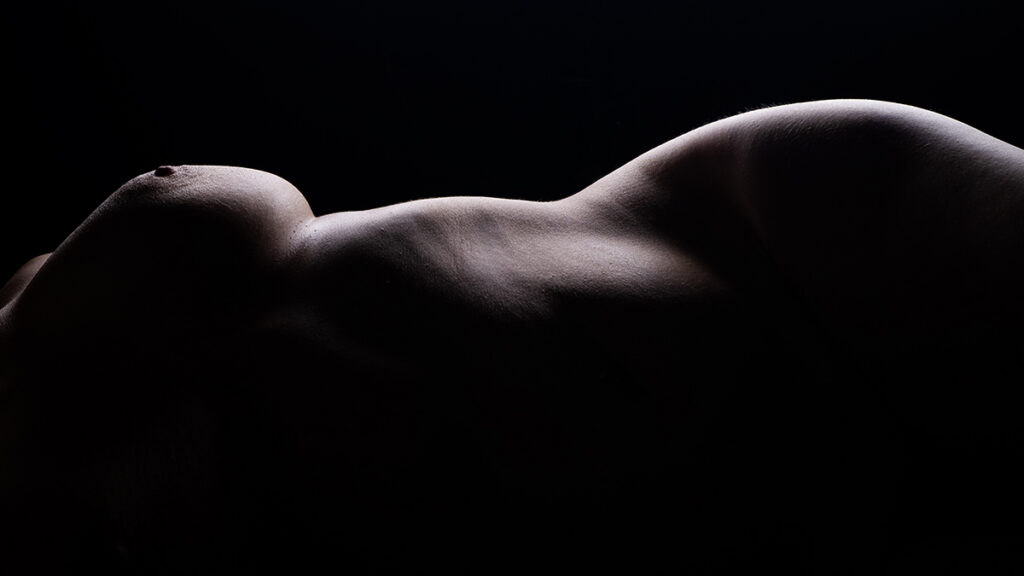
The term combines body and landscape. It describes photography in which the human body is no longer presented primarily as a complete person, but as form, surface and landscape. A back becomes a range of hills, a waist becomes a valley, the curve of a hip becomes a horizon. A shoulder emerges from blackness like a cliff illuminated by the low afternoon sun, while the rest of the body disappears completely into darkness just a few centimetres away.
At some point, the photographer stops seeing backs, shoulders, stomachs and hips. Instead, one begins to see lines, planes and transitions between light and shadow. The interesting question becomes how little information is needed for the human brain to reconstruct a recognisable body.
An Idea Older Than Its Name
As so often happens in photography, the idea is considerably older than the name we use for it today. Looking at the human body as a formal structure is certainly not an invention of photography. Sculptors and painters have explored it for thousands of years. During the nineteenth century, photographic nude studies frequently served as references for artists. The boundaries between academic study, scientific documentation and independent artwork were not always clearly defined.
Things become particularly interesting when photographers begin to do more than simply depict the body. By using cropping, perspective and light, they separate it from our familiar ways of seeing. During the early twentieth century, this approach became increasingly radical. Modern photography discovered that a person did not have to be shown in their entirety. A fragment could be enough. A line could be more important than anatomical completeness. Light could divide, simplify and reconstruct the body.
Edward Weston offers an obvious example. His nude photographs from the 1920s and 1930s repeatedly explore the body as a sculptural form. Bodies, shells, peppers and landscapes become subjects of related formal investigations. He was interested in lines, volumes and surfaces, revealing remarkable visual similarities between things that otherwise have little in common.
This transformation becomes even more striking in the work of Bill Brandt. His nude photographs, especially those from the 1940s and 1950s onwards, use unusual perspectives and extreme cropping to distort familiar bodily proportions. Knees, legs and backs acquire something approaching the dimensions of landscapes. Man Ray had already demonstrated how experimental processes, light and photographic composition could move the human body away from traditional representations of the nude.
The term “bodyscape” became particularly associated with the American photographer Allan I. Teger, who began his Bodyscapes series in the mid-1970s. His approach, however, follows a distinct concept. He placed miniature figures on naked bodies, transforming their surfaces into apparently real landscapes. In his photographs, the metaphor becomes almost literal.
The underlying photographic idea of presenting the body as landscape or abstract form existed long before that. Naming a single inventor of bodyscape might be convenient for an encyclopaedia entry, but it would be rather questionable art history.
When Does a Body Become a Landscape?
What fascinates me most about bodyscape is the moment when perception shifts. As long as I photograph a person in their entirety, we primarily see that person. Face, posture and expression determine our response. But when I begin removing visual information, the image changes.
The face disappears, perhaps followed by the hands. The framing becomes tighter. Only the back, waist and hips remain. Eventually, I illuminate only a small part of them. At some point, we are no longer primarily looking at a woman against a black background. We are looking at a bright line emerging from darkness, changing direction, swelling, narrowing and finally disappearing.
Our brains do a remarkable amount of work. Very little information is needed to recognise human shapes. An illuminated contour suggests a shoulder, two curves suggest a back. Some images are immediately understandable; others remain mysterious for a moment. We know that we are looking at a body, but not necessarily which part.
It is precisely this movement between recognition and uncertainty that interests me. It also distinguishes bodyscape from many traditional approaches to nude photography. The body no longer has to remain anatomically complete. Skin becomes surface, a curve becomes a line, shadow becomes a plane.
Eventually, the question of whether the photograph depicts a naked person becomes surprisingly unimportant.
Nudity Is Not Automatically Erotic
This brings me to a distinction that matters greatly in my photography: nudity and eroticism are not the same thing.
A person can be photographed completely naked without the resulting image being erotic. Conversely, a photograph revealing very little skin can be highly suggestive. Eroticism is not determined by reaching some statistically sufficient number of visible square centimetres of skin. It arises through posture, gaze, gesture, context and the relationship a photograph establishes with its viewer.
In low-key bodyscape, the erotic interpretation often retreats even further. I am not interested in how much skin I can show, but in how little of the body is needed to make a form work. A completely naked back can resemble a sculpture rather than an erotic image. A hip can dominate a composition without necessarily referring to sexuality.
Naturally, erotic associations cannot simply be prohibited. They also exist in the eye of the beholder. But there is an important distinction between a photograph designed to make a body desirable and one created to investigate its forms.
My interest lies in the latter. The body does not have to perform. It does not have to seduce. It can simply be form.
Every Woman Looks Good in Low-Key Bodyscape
I realise that I am making a rather bold claim. Nevertheless, experience has convinced me that it is true: every woman can look good in low-key bodyscape.
And no, this does not mean spending hours pushing, liquefying and retouching things in Photoshop until the person in the photograph bears only a distant family resemblance to the woman who stood in front of the camera.
The reason is almost the opposite. Bodyscape sets aside many of the criteria by which bodies are normally judged.
Our idea of a “photogenic body” is astonishingly narrow. Advertising, fashion photography and social media have spent decades presenting bodies that are supposed to appear young, slim, firm, smooth and symmetrical. We then seem surprised when real people stand in front of a camera and apologise for their stomachs, their upper arms or skin that is no longer perfectly smooth.
The problem is not the real body. The problem is the standard against which we measure it.
In bodyscape, that standard interests me very little. I am not looking for a clothing size. I am looking for lines. A fuller body has different lines from a slender one. Soft tissue responds differently to grazing light than pronounced musculature. A body at sixty has different surfaces and transitions from a body at twenty. Wrinkles, curves and skin texture can produce forms that perfectly smooth skin simply does not possess.
These are not defects to be eliminated in post-production. They are the material from which the photograph is created.
I have photographed women weighing considerably more than one hundred kilograms and women well past sixty. During such sessions, one sometimes encounters remarkably harsh self-judgement. People know their bodies from mirrors, snapshots and comparisons with images of other people.
A bodyscape can show that same body according to entirely different visual rules. There is no clothing size to identify, no age printed beneath the photograph. Instead, we see a curve, a strip of light or a shoulder transformed into an independent graphic form.
This does not mean that all bodies look the same. Quite the opposite. Every body has its own forms and possibilities.
The body does not have to be suitable for the photograph. The photographer has to find the right light for the body.
My task is not to force the person in front of my camera into a predetermined ideal. It is to discover what kind of image this particular body makes possible.
That is a fundamental difference.
Trust Begins Before the First Photograph
Someone considering this kind of session may feel curiosity, but also uncertainty. People who have never had artistic nude photographs taken often wonder whether their bodies are suitable, how much they will have to reveal and whether they will feel comfortable in front of the camera.
These are perfectly reasonable questions. Standing undressed in front of a photographer is hardly an everyday experience.
For me, photographic skill includes not only mastery of light but also respect for the person being photographed. The intended images, which parts of the body will be visible and where personal boundaries lie should all be discussed clearly beforehand. Nobody should feel pressured into a pose or degree of nudity that makes them uncomfortable.
The use of the resulting photographs is a separate matter. Agreeing to be photographed does not automatically mean agreeing to publication. Whether the photographs remain private or may be shown publicly must be explicitly agreed upon.
Bodyscape can make the experience easier because the image often requires neither a visible face nor a complete view of the naked body. Yet the decisive factor is not simply what the final photograph reveals. It is also how the person feels while it is being made.
A strong photograph does not depend on the model revealing as much as possible. It depends on light, form and trust working together.
A Remarkable Way to Preserve Anonymity
Bodyscape offers another advantage: anonymity can be part of the composition from the beginning.
Some women would like to have artistic body photographs taken but do not want their faces published. In many photographic approaches, attempts to accommodate this become immediately obvious. The head is awkwardly cropped, the face demonstratively turned away or concealed behind hair and hands until the message “Please do not recognise this person” becomes almost the main subject of the picture.
In bodyscape, this visual problem largely disappears. The face can simply be absent, and nobody misses it. If the composition consists of a back, shoulder and hip, there is no artistic reason why a head should appear above them.
Of course, omitting the face does not guarantee complete anonymity. Tattoos, distinctive scars and other identifying features may still make someone recognisable. Such details must also be considered when anonymity matters.
Handled carefully, however, bodyscape offers an elegant way of keeping one’s identity largely outside the frame without sacrificing the artistic quality of the image.
Only the Setup Is Simple
Anyone who assumes this kind of photography must be wonderfully uncomplicated is partly right. Surprisingly little equipment is needed: a black background, a camera, a suitable light source – often a strip softbox in my case – and a body.
No elaborate scenery, no four-poster bed, no antique furniture and certainly no twenty-light setup.
Nevertheless, I warn my models in advance that positioning the body in relation to the striplight can take time. And before anyone draws the wrong conclusions from the words “nude photography” and “striplight”: it is not called that because the model strips in front of it. It is simply a long, narrow softbox. I cannot be held responsible for the entertainment value of the terminology.
The real work begins once the model and the light are in position. A single centimetre can make an astonishing difference. Turn a shoulder slightly too far and a delicate line of light becomes a broad bright area. Move the hip back and a beautiful contour disappears. Shift the pelvis or transfer weight to the other leg, and suddenly the entire composition changes.
From the outside, this probably looks rather absurd: “A little to the left. Stop. Slightly back. No, that was already too much.”
Sometimes the difference between too much and too little really is just one centimetre.
That is because bodyscape is not simply about illuminating a body. Light is used to describe it. Light determines which line appears and which disappears. And because every body is different, there is no universal pose that can simply be repeated with every woman.
You have to look, adjust, look again and occasionally reverse the very movement you were convinced would improve the picture ten seconds earlier.
Low-Key Is Not a Fancy Word for “Too Dark”
One misunderstanding appears repeatedly: low-key photography is confused with underexposure. Both types of photograph can appear dark and contain large black areas. Yet they are not the same thing.
In an unintentionally underexposed photograph, light is missing where visual information should have been recorded. In a deliberately composed low-key photograph, the photographer decides from the beginning which areas should be visible and which may remain dark.
Darkness is not a mistake. It is a design element.
I do not illuminate an entire body and then simply darken the finished photograph. I decide during the session which areas should receive light at all. Black does not always need to contain recoverable detail. It is allowed to remain genuinely black.
What matters is whether the illuminated parts have the brightness and tonal detail the photograph requires.
In the second part, I will explore the technical process: positioning the striplight, the effects of the smallest movements and correct exposure. We will also encounter a little diagram that photographers sooner or later learn to appreciate: the histogram.
To non-photographers, that probably sounds about as exciting as a dishwasher instruction manual. In practice, however, it provides a remarkably clear explanation of why a photograph consisting largely of black areas can be perfectly exposed.
Darkness alone does not make a photograph low-key.
Just as an out-of-focus photograph does not automatically become Impressionist merely because someone gives it a French title.
What Fascinates Me About It
Perhaps I return to low-key bodyscape so often because it shares so much with the ideas I explore through Artis Umbrae. The works are not identical, and I have no intention of artificially merging them. But they sometimes speak the same photographic language.
Light is not there to reveal everything. Shadow is not an unfortunate by-product of illumination but an independent element of composition. The body does not need to be shown completely in order to have a presence. And reduction does not mean that the photographer has run out of ideas.
Quite the opposite. The fewer elements an image contains, the more precisely the remaining ones must work.
In boudoir photography, I am more interested in the person. Face, expression, posture and atmosphere play important roles. Bodyscape allows me to move further towards abstraction. The body remains real while becoming something else: a line, a plane, a sculpture, a landscape.
Which brings me back to my perhaps rather audacious claim: every woman can look good in low-key bodyscape.
Not because darkness conceals supposed imperfections. That explanation would be far too cheap. It works because this photography approaches the body according to different criteria. It does not ask how closely someone resembles a standardised ideal of beauty. It asks what forms this particular body possesses and what light can create from them.
I do not have to invent anything.
I simply have to look long enough.
And sometimes ask the model to turn another centimetre to the left.