
There are certain questions that, as a nude photographer, one encounters with surprising regularity. “What kind of women are these, actually, that allow you to photograph them?”
That is the more polite version The less polite version is often: “Are they prostitutes?” Other favourites include: “Doesn’t that turn you on?” or “I wouldn’t be able to control myself.”
Sometimes such remarks are made jokingly. Sometimes out of genuine curiosity. Sometimes with that peculiar self-satisfied tone of people who believe they have just expressed a profound truth about life.
What has always fascinated me about these questions is not the answers, but the questions themselves. Because everything is already contained within them.
A naked body appears, and immediately the process of attribution begins. Suddenly people believe they know something about the character of the woman in the image. About her morals. Her intentions. Her sexuality. Her motivations. They have never spoken to her. They know nothing of her story, her hopes, her fears, or her thoughts. But they have seen her body. Apparently, that is enough.
The truly amusing part begins when one actually knows the people standing in front of the camera.
The woman who agreed to serve as a projection surface for this series reveals her body in these images. What she does not reveal is her intellect. She does not reveal the conversations we have about art, philosophy, and society. She does not reveal the objections she raises when I present new concepts. She does not reveal the questions she asks that sometimes stay with me for days afterwards. Nor does she reveal those moments when a seemingly simple idea develops into something far deeper because she refuses to be satisfied with merely looking good in front of a camera.
All of that remains invisible. Breasts, however, are visible.
And remarkably, for some people that is already enough to form a judgement about an entire human being.
This phenomenon is by no means limited to men. While we men have spent thousands of years demonstrating a certain reluctance to reduce women exclusively to their intellect and inner qualities, experience shows that similar questions are often asked by women as well. Apparently, the human imagination possesses a remarkable talent: it sees a naked body and confidently invents the rest.
Perhaps that is where the true humour of these questions lies. Not in the fact that they are asked, but in how much they reveal about the person asking them.
This series was not born out of outrage. Outrage is usually rather boring. It was born out of curiosity. Out of the question of what actually happens when we look at another human being. What do we really see? What do we add? What stories do we invent? What judgements do we make? And at what point do we stop seeing the person before us and begin seeing only the image inside our own minds?
The words written on the body do not answer these questions. They ask them. Perhaps these images therefore tell us less about the woman depicted in them than about those who are looking at her.
Because in the end, one uncomfortable possibility remains: That it is not the nudity that is being exposed here.
IUDICAS?
(Do You Judge?)
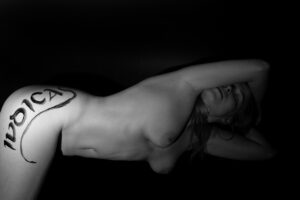
This image poses the first question of the series. Not to the woman, but to the viewer.
Judgements are often formed with astonishing speed. A single glance is enough, and we believe we know who a person is, what they think, what they want, or what intentions they might have. The image does not answer these assumptions. It merely raises an uncomfortable question: does the judgement truly arise from the image, or from the mind of the person looking at it?
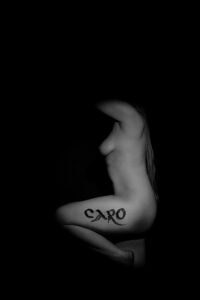
CARO
(Flesh, Corporeality)
The Latin word caro means more than simply flesh. It refers to the human body, embodiment, and physical existence itself.
The body appears here as a visible reality. At the same time, it remains unclear whether the viewer is truly seeing a human being or merely a physical shell. The question is not whether the body is present. The question is whether we are capable of seeing beyond it.
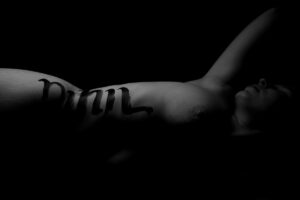
NIHIL
(Nothing)
A fragment of a body surrounded by darkness.
The word nihil may be read as emptiness, absence, or the refusal of a clear statement. Perhaps there is nothing there. Perhaps everything is there. The image invites us to question the meanings we add ourselves.
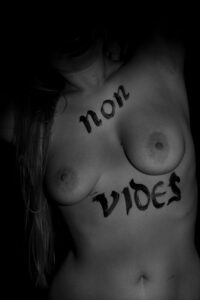
NON VIDES
(You Do Not See)
We look at images and convince ourselves that we have understood them. But what exactly have we seen? A person? A body? An idea? A fantasy? The image suggests that the real mistake may not lie in what is seen, but in the belief that we have already understood everything.
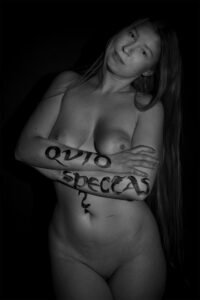
QUOD SPECTAS?
(What Do You See?)
At first glance, the question appears simple. In reality, it may be the central question of the entire series.
What do we see when we look at a naked human being? Anatomy? Beauty? Sexuality? Vulnerability? Art?Or are we merely looking at our own expectations, prejudices, and desires?The image offers no answer. It leaves that decision to the viewer.
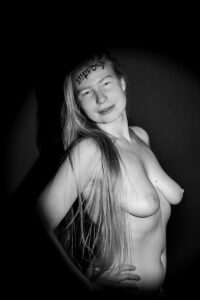
IMPUDICA
(Shameless)
This is the only word in the series that already contains a judgement.But whose judgement is it? Does it describe the woman in the image? Or does it describe the thoughts of the person applying the label?
At the end of the series, it remains unclear who is actually being judged. Perhaps the woman. Perhaps the gaze directed towards her.