
The Weight of the Unspoken
A photographic series exploring the many faces of silence
Silence is often perceived as an absence: an empty space between words, a moment in which nothing is said. Yet silence is never without meaning. It can arise from fear or shame, from love or guilt. It can protect, express consent, create intimacy, become a punishment, or be imposed by power.
What appears identical on the outside can carry entirely different meanings within. One person remains silent to avoid hurting someone. Another remains silent because the possibility of speaking has been taken away. Silence can preserve – and it can destroy. It can be an expression of profound intimacy or a form of exclusion.
The series SILENTIUM explores these invisible differences. Posture, gaze, gesture, light and shadow take on what language no longer expresses. The nude body does not become an object of observation, but a bearer of inner states: vulnerable, protective, withdrawn, confined or deeply trusting.
The shadow is more than a mere consequence of light. It accompanies the figure like the unspoken itself – sometimes as a protective space, sometimes as a burden, sometimes as an opposing presence. In some images, it intensifies the inner state; in others, it contradicts it or reaches beyond the body.
The individual works do not offer definitive answers. Instead, they raise questions: Why does a person remain silent? Whom does this silence serve? Whom does it protect – and who bears its consequences?
Gallery

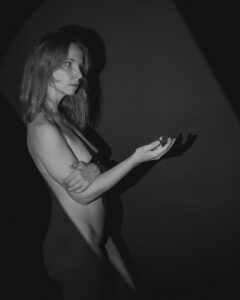

TIMOR
Silence out of fear
Fear does not always deprive the voice of words. Sometimes it leaves them frozen, suspended before they can be spoken.
The figure recoils as a dark wedge intrudes into her space. One hand protects the chest and throat; the other reaches cautiously towards an invisible threat. Her gaze remains alert, as though every word must first be weighed against its possible consequences.
The shadow intensifies the sense of danger and pushes the body towards the edge of the image. Silence becomes a strategy for survival: not an expression of consent, but an attempt to avoid further harm through invisibility and restraint.
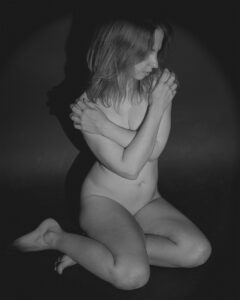
PUDOR
Silence out of shame
Shame causes a person to withdraw into themselves. The body attempts to cover itself while also retreating from view. The crossed arms protect more than nudity; they surround the figure like a self-imposed boundary.
The lowered gaze avoids an encounter. Not because there is nothing to say, but because speaking would mean becoming visible. Silence protects against exposure – while at the same time holding the person captive within it.
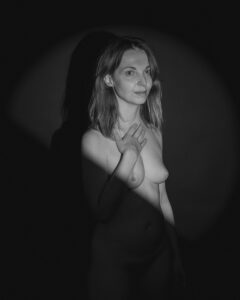
CUSTODIA
Silence as protection
Not every silence conceals. Some forms of silence preserve.
The hand resting over the heart appears like a silent promise. What has been entrusted is not revealed. The open gaze shows neither fear nor hesitation. This silence does not arise from weakness, but from responsibility.
The shadow reaches across the body, forming a second, darker layer of protection. Silence becomes a space in which something remains safeguarded because words would expose it.
AMOR
Silence out of love
Sometimes the truth remains unspoken because it might hurt another person. The outstretched hand appears to offer something – while simultaneously holding it back. The other hand embraces the body, revealing that even protective silence may come at a price.
Love and concealment do not appear here as opposites. Silence arises from care, yet remains ambiguous: does it truly protect the other person, or does it also shield the one who remains silent from the consequences of what might be said?
ASSENSUS
Silence as consent
Those who remain silent do not object. But does that already constitute consent?
The figure stands upright and still. Her gaze does not turn away. One hand rests on her body while the shadow covers part of the visible figure. There is no resistance, but neither is there an explicit declaration.
The image points to the moral uncertainty of silent consent. Silence may signify agreement. But it may also reflect convenience, conformity or a refusal to accept responsibility for a decision.
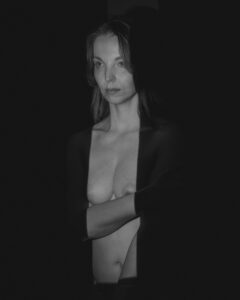
CULPA
Silence out of guilt
Guilt rarely speaks directly. It averts the gaze, withholds words and attempts to keep what has happened within.
The figure stands openly before the camera, yet remains distant. Her gaze seeks no contact. Dark geometric shadows cut across the body and cover it like something that cannot be cast off.
Here, silence does not protect against injury, but against disclosure. Yet what remains unspoken does not disappear. It remains inscribed in the body.
POENA
Silence as punishment
Silence can be a weapon.
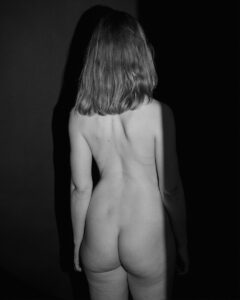
The figure turned away withholds not only her words, but also her gaze, her face and the relationship itself. The other person is not hurt by an action, but by its refusal. Communication is withdrawn without its ending ever being spoken.
The back becomes a boundary. Silence creates distance and forces the other person to remain within an empty space. What appears passive on the outside can become a form of control and punishment.
COACTIO
Enforced silence
Here, silence is not a choice.
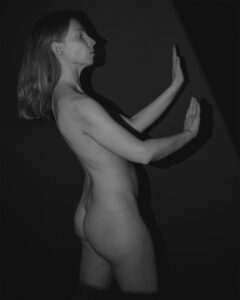
The raised hands form a boundary. They appear to resist while simultaneously being pressed against something invisible. Body and shadow duplicate the gesture, as though the space itself had become an obstacle.
Enforced silence emerges wherever power prevents speech – through fear, dependency, threats or violence. The voice has not disappeared. It is being suppressed.
INTIMITAS
Shared silence
There is a form of silence that conceals nothing and demands nothing.
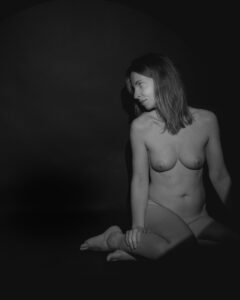
The figure sits quietly at the edge of the image. Her gaze is directed towards the empty space – towards a presence that does not need to be visible. The broad expanse of open space does not become absence, but the place of a familiar presence.
When closeness no longer requires explanation, words lose their necessity. This silence does not separate. It is a shared space in which nothing needs to be proven, defended or spoken.
CONVIVIUM – The Culinary Interpretation
SILENTIUM is complete as a photographic series. Its culinary interpretation is still open.
The works form part of CONVIVIUM, an open dialogue between photography and the culinary arts. The images are neither illustrated nor simply “translated” into dishes. Drawing on the themes, atmospheres and inner tensions of the series, chefs develop an independent culinary interpretation.
What might silence taste like?
Can a dish withhold something? Can a sequence of flavours make protection, shame, guilt or an unspoken sense of closeness perceptible? How does a menu change when restraint, rather than abundance, becomes a means of expression? And can that kind of silence emerge between two courses – a silence in which perception becomes more intense?
For SILENTIUM, a nine-course menu could be conceived in which each photographic work becomes the starting point for an independent culinary interpretation. The role of the kitchen is not to illustrate the images, but to respond to them with its own means of expression: flavour, aroma, temperature, texture, time and memory.
Invitation to Collaborate
Chefs, restaurants, hotels and gastronomic establishments interested in interdisciplinary collaboration are invited to develop their own culinary interpretation of SILENTIUM.
The aim is neither to provide simple culinary accompaniment to an exhibition nor to create a decoratively themed menu. The objective is an equal dialogue between two forms of artistic expression: photography and cuisine.
The specific form of the collaboration can be developed together and adapted to the location and context – as an exclusive menu, a photographic and culinary evening, an exhibition accompanied by a gastronomic interpretation, or an independent event within CONVIVIUM.
Interested in a collaboration?
I would be pleased to discuss the possibilities in person.
Button:
Propose a Collaboration
Small text below:
The photographic series is complete. The culinary interpretation is open.
The photographic series is complete. The culinary Interpretation is open.