
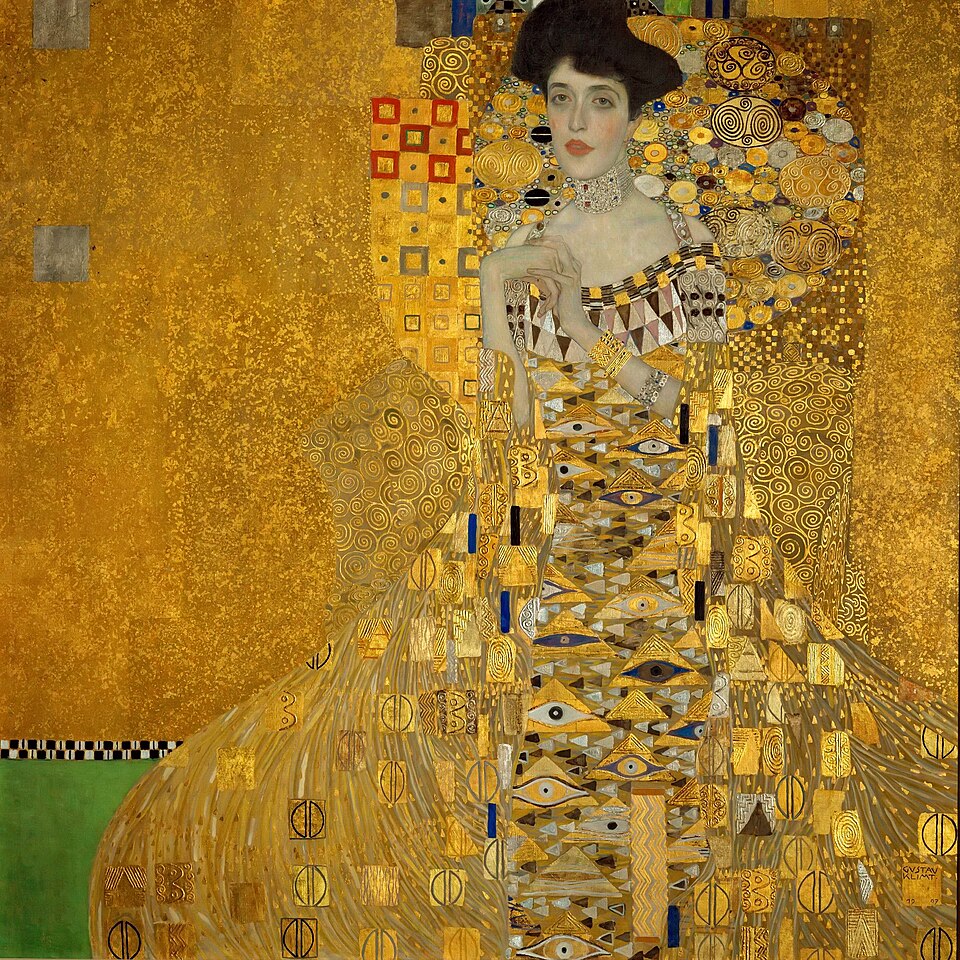
On Gustav Klimt, the mosaics of Ravenna, and the art of drawing inspiration from the past without copying it.
A Second Discovery
In the first article of this small series, I explored the unusually clasped hands of Adele Bloch-Bauer. It was a gesture I had noticed several times before in Gustav Klimt’s famous portrait, although I only recently encountered a possible explanation in a video. My subsequent research led me to questions of beauty, idealisation and individuality. But as I continued studying the painting, an entirely different aspect increasingly attracted my attention: the gold.
Of course, I was already familiar with Klimt’s extraordinary use of gold. After all, it is among the most distinctive features of his best-known works. Nor was the connection between his ornamental visual language and Byzantine art entirely new to me. But now I wanted to understand more precisely what Klimt had actually seen, what impressions he brought back to Vienna, and how this peculiar combination of the human figure, ornament and precious surfaces had developed—a combination that makes his paintings so unmistakable to this day.
My research led me to Ravenna, a city that was among the most important centres of late antique and early Byzantine art in the sixth century. Some of the most remarkable surviving mosaics from that period can be found there. And it was there, in 1903, that Klimt encountered a visual world fundamentally different in several respects from the naturalistic painting in which he had been trained. This brought me to a question that has occupied me for a long time and is becoming increasingly important in my own artistic work: How does something new emerge from engagement with something old? Where does inspiration end and imitation begin? And what transforms an adopted visual language into an independent artistic statement?
Ravenna – A Different Conception of the Image
Anyone studying the Byzantine mosaics of Ravenna encounters an art whose purposes differ significantly from those of later European illusionistic painting. Particularly impressive are the mosaics in the Basilica of San Vitale, including the famous depictions of Emperor Justinian and his wife, Empress Theodora, accompanied by their respective entourages. Both works were created in the sixth century, during the period of Byzantine rule over Ravenna. They belong to a representational and religiously informed visual order in which the status of the figures portrayed is just as important as their physical appearance.
Image reference: The two mosaics can be found online using the search terms Ravenna San Vitale Empress Theodora mosaic and Ravenna San Vitale Emperor Justinian mosaic.
The figures stand largely facing the viewer, their bodies appear comparatively flat, and the spatial relationships do not consistently follow the rules of perspective with which we have become familiar since the Renaissance. This does not mean, however, that artists of the period were incapable of depicting people or spaces naturalistically. Late antique art possessed sophisticated means of representing bodies, fabrics and spatial depth. In Ravenna, rather, we encounter artistic choices in which frontality, hierarchy, symbolism and precious materials serve purposes other than creating the most convincing possible imitation of visible space.
I find the role of gold particularly interesting. It is not simply an expensive background or a demonstration of wealth. The golden glass tesserae reflect incoming light and thereby transform the effect of the entire composition. Depending on the viewer’s position and the lighting, a different interplay of brightness and reflections emerges. The surface itself becomes an active component of the image. Whereas illusionistic painting often attempts to conceal its own material nature behind a convincing representation of reality, the mosaics turn their materiality into an event in its own right.
The different treatment of figure and surroundings is equally remarkable. Theodora’s face possesses individual features and a certain degree of three-dimensional modelling. Her garments, by contrast, are dominated by rich ornamental patterns that simultaneously communicate the quality of the fabrics, dignity and rank. The human body does not disappear entirely, but it is subordinated to an overarching visual order. The aim is not to depict an empress at some accidental moment in her life. The mosaic presents a ruler within a religious and imperial order. This different conception of the image must have been of particular interest to a painter like Klimt, who was increasingly distancing himself from the established conventions of academic painting.
Klimt’s Journeys – and His Enthusiasm
Klimt actually visited Ravenna twice in 1903. In May, he saw its mosaics for the first time. The impressions were evidently strong enough to bring him back in late November and early December of the same year. On this second journey he was accompanied by the painter and Secession member Maximilian Lenz, whose recollections, published later, contain a remarkable account.
Lenz reported that the shimmering golden mosaics made an overwhelming impression on Klimt. The usually reserved artist apparently found it difficult to put his enthusiasm into words, but his deep emotion was clearly apparent. This is the recollection of a travelling companion, written down and published some time after the event. It is therefore particularly revealing that we also possess a statement made by Klimt himself at the time.
On 2 December 1903, he wrote to Emilie Flöge from Ravenna. The city itself seems to have impressed him rather little; he found much of it shabby. The mosaics, however, he described as being “of unheard-of splendour” (von unerhörter Pracht).
These few words are revealing. Klimt, who apparently was not inclined to describe his artistic impressions at great length, explicitly regarded the mosaics as extraordinary. Nevertheless, we should not construct the myth of a single revelation from which his entire Golden Phase suddenly emerged. Klimt had already been deeply engaged with ornamental surfaces, Symbolist ideas and the relationship between painting and the decorative arts. His artistic development was also shaped by the Vienna Secession, his training at the School of Arts and Crafts, and international artistic movements.
Ravenna was therefore less the beginning of an entirely new development than an encounter that gave an additional direction to interests he already possessed. There, Klimt found a historical art in which human figures, precious materials, ornamental structures and symbolic meanings were combined into an unusually coherent visual effect.
The Empress and the Viennese Lady
Let us now consider his portrait of Adele Bloch-Bauer, completed in 1907. At first glance, the comparison with Theodora seems almost obvious. Both women are surrounded by an abundance of precious ornamentation. Gold determines the visual impact. Faces and hands emerge from surroundings in which patterns and surfaces appear more important than a convincing representation of spatial depth.
In fact, this comparison is by no means a modern invention. As early as 1907, when Klimt’s painting was first exhibited publicly, the Viennese art critic Ludwig Hevesi associated the portrait with the mosaics of Ravenna, particularly the depiction of Theodora. The relationship between these two visual worlds was thus already recognised by Klimt’s contemporaries.
Image comparison: Gustav Klimt, Portrait of Adele Bloch-Bauer I, 1907, Neue Galerie New York, and the mosaic Empress Theodora and Her Retinue, c. 547, Basilica of San Vitale, Ravenna. Search term for the mosaic: Ravenna San Vitale Theodora mosaic. A public-domain reproduction may be used for the Klimt painting.
But let us look more closely. In the mosaic of Theodora, the distinction between face, clothing and background remains largely understandable. We recognise the empress, her attendants, the architectural elements and the precious fabrics. Although the composition is organised in a relatively flat manner, its individual components remain largely distinguishable from one another.
With Adele, Klimt takes this principle considerably further. Her face and hands are painted with great sensitivity. The skin possesses volume, the facial features are individual, and the slightly flushed cheeks and red lips create an immediate sense of physical presence. Below them, however, the body increasingly seems to dissolve into an intricate network of geometric forms, eye motifs, spirals and golden surfaces. It is not always clear where the dress ends, where the chair begins and where the background takes over. Even the question of whether Adele is standing or sitting cannot be answered at first glance.
This creates a tension that I consider essential to the painting’s effect. Adele is simultaneously a specific, physically present woman and part of an almost abstract ornamental order. Her face is individual, while her surroundings largely escape the rules of natural space. Her realistically depicted hands consequently acquire extraordinary significance. They are among the few parts of the painting that remind us directly of a human body.
The ornaments themselves also deserve closer examination. The ALBERTINA documents a large number of preparatory drawings for this portrait and explicitly identifies Egyptian eye motifs, as well as geometric forms for which Klimt drew inspiration, among other sources, from Japanese signature seals. His visual language therefore cannot be reduced to a single historical origin. Byzantine mosaics, Egyptian motifs, Japanese design elements and the decorative principles of Viennese modernism come together.
And this, to my mind, is where the true artistic achievement lies. Klimt did not simply adopt the image of a Byzantine empress and replace her with a Viennese lady. He drew upon various historical visual devices, transformed their functions and used them to create a pictorial order that made entirely new effects possible within a modern society portrait. The result is neither a Byzantine mosaic nor a conventional portrait of the early twentieth century. It is Klimt.
What Gold Does to an Image
Beyond composition, another comparison deserves attention, one that can easily be overlooked: materiality. For gold is not always the same as gold. In Ravenna, the luminous surfaces consist of small mosaic pieces, including glass tesserae containing layers of gold leaf. Their differing angles and surfaces influence the way light is reflected. The mosaics are part of the architecture and unfold their effect in physical space, through movement and under changing lighting conditions.
Klimt, by contrast, worked on canvas with oil paint, gold and silver. He transferred the idea of a precious, light-responsive surface into a different medium. The mosaic tesserae disappeared, replaced by painted patterns and metallic areas. Architectural integration gave way to the independent easel painting. Gold remained an essential artistic device but acquired a different material and social function.
In San Vitale, gold appears within a sacred space and an imperial system of representation. In Klimt’s painting, it becomes part of a private portrait from the cultural milieu of Vienna’s affluent bourgeoisie. The sacred significance of the Byzantine visual world cannot simply be transferred to Adele. What we can observe, however, is that Klimt uses a visual language that gives the woman portrayed an almost otherworldly presence.
To me, this is a particularly clear example of how the materiality of an artwork involves far more than its technical execution. It changes the way we perceive the image. A mosaic, a painting incorporating metallic materials, an ordinary colour print and a photograph on textured paper can depict similar subjects and yet produce entirely different experiences. The support and the production process are not necessarily neutral means of reproducing an already established artistic idea. They may themselves be part of that idea.
The Past as a Toolbox
We tend to view art history as a succession of periods. Gothic art is followed by the Renaissance, Baroque by Rococo, and later come Neoclassicism, Romanticism, Impressionism and the various movements of modern art. This classification helps us organise developments and understand historical contexts. But it can also create the impression that every new period replaced the previous one and somehow rendered its artistic possibilities obsolete.
In reality, art history does not operate in such a straightforward manner. Artists have repeatedly returned to earlier forms, reinterpreted them, combined them or consciously employed them against the prevailing assumptions of their own time. The Renaissance engaged intensively with antiquity. In the nineteenth century, the Pre-Raphaelites sought alternatives to certain academic conventions, taking inspiration from art created before Raphael. Modern artists rediscovered medieval modes of representation, archaic forms and non-European artistic traditions as possible alternatives to European naturalism. The latter, however, did not always occur under fair or equal conditions. Engagement with other cultures could produce insight and artistic renewal, but it could also be shaped by colonial power structures, misunderstandings and insufficient recognition of the cultures from which these forms originated.
Not every appropriation of historical forms is therefore automatically an artistic achievement. One can imitate a style without understanding its foundations. One can borrow ornaments because they seem decorative or use a historical printing technique because the result looks old and precious. That may be aesthetically appealing, but initially it remains a borrowed effect.
For me, things become interesting when engagement with the past opens up a new artistic possibility. Someone who understands why an artist abandoned perspective, why a particular surface was chosen or what role an ornamental pattern played within a visual composition gains more than a collection of historical motifs. They acquire tools with which to develop their own artistic ideas.
Art history thus becomes a kind of toolbox. Not in the sense of an arbitrary collection of effects to be pulled out whenever convenient, but as a reservoir of different solutions to artistic problems. Some of these solutions are centuries old. That does not necessarily make them any less useful.
Intellectual Curiosity as an Artistic Driving Force
My intensive engagement with art history is driven above all by a thirst for knowledge. I want to understand why certain images affect us, what decisions their creators made and what conceptions of art, reality and beauty lay behind them. I am interested not only in the finished artwork but also in the path leading to it: the historical circumstances, the materials used, the technical possibilities and the considerations from which a particular visual language emerged.
This curiosity has a direct influence on my photography. I study the lighting of classical portrait painting, the bodily expressions of Expressionist dance, Symbolism and visual reduction, as well as photographic movements that did not regard the medium exclusively as a tool for the most accurate possible reproduction of reality. I do not necessarily want to adopt everything I discover. Some historical solutions strike me as unconvincing today; others cannot meaningfully be transferred to my own work. But every serious exploration broadens my understanding of what images can achieve.
For some time now, Pictorialist photography has been of particular interest to me. Its practitioners wanted to demonstrate that photography need not be limited to technical precision and documentary representation. They experimented with soft focus, tonal values, special papers and elaborate printing processes. Some drew inspiration from painting, while others sought an independent photographic form of expression. Not all these works appeal to me equally. But their central question remains relevant: How can a technically produced photograph become an independent artistic image?
This exploration gave rise to my project ARS IMPRESSA. It is not a short-term experiment but an extended research and art project in which I investigate historical photographic printing processes, compare their aesthetic characteristics and explore ways of combining them with contemporary digital photography. If the research and practical experiments produce the hoped-for results, the project is intended eventually to lead to another book. It would bring together art-historical research, technical processes, my own experiments and their artistic outcomes.
Among the processes that interest me are platinum and palladium printing, gum bichromate printing, carbon or pigment printing, and salted paper printing. Each has its own material qualities, characteristic tonal values and particular possibilities for image-making. I do not wish merely to imitate them because their surfaces possess a nostalgic charm. What interests me is what they do to an image. Which qualities of a photograph does a particular process emphasise? Which are lost? What happens to contrast, fine detail, tonal transitions and our perception of light? And which of these characteristics can be reproduced through digital means, while others remain inseparable from the physical material?
One distinction is particularly important to me: a digital simulation of a platinum print is not a platinum print. It may reproduce certain visual characteristics, but it cannot replace the production process, material structure and physical presence of the original technique. Nevertheless, such a simulation can also be artistically meaningful if used consciously and without pretending to be something else. Conversely, merely mastering a historical printing process does not automatically turn a photograph into a compelling artwork.
This is precisely where art history, technology and artistic creation meet for me. The past does not supply ready-made answers. It expands the possibilities for asking questions of my own.
Between Imitation and Transformation
Of course, Klimt’s approach to Byzantine art cannot be directly equated with the use of historical photographic printing processes. He worked with different materials, in a different social environment and with different artistic intentions. Nevertheless, I recognise a methodological similarity: the conscious study of existing visual languages in order to develop new creative possibilities.
Simply adopting visible results is not enough. Anyone who reduces Klimt to golden surfaces and decorative patterns has missed an essential part of his achievement. What matters is how he combines the individual elements, what tensions arise and what significance they acquire within the work as a whole. The contrast between Adele’s physical presence and her almost abstract surroundings shows particularly clearly that the borrowed artistic devices are not merely decorative embellishments. They contribute to the meaning and effect of the painting itself.
The same applies to photography. An image does not become artistically interesting simply because it resembles a nineteenth-century photograph. An elaborately produced gum print is not automatically a good artwork. Nor does a digital photograph lose its artistic value because it was created using modern tools. The process can support, deepen or transform an artistic statement. It cannot replace that statement.
When examining historical models, I therefore consider it useful to ask not only how something was made, but above all why it was made that way and what effect resulted. Only then does the question arise of whether these considerations can be applied to one’s own work. Perhaps this is one of the most important functions of art-historical research for a practising artist: it opens up alternatives to the creative assumptions of the present. What seems natural, correct or technically optimal to us today is often merely one possibility among many developed over the course of history.
Nothing New Emerges from Nothing
The notion of the artist as a solitary genius who creates entirely new forms through pure inspiration is one of art history’s most persistent myths. Even where genuinely radical innovations occurred, connections can almost always be traced to earlier works, existing techniques, social developments and other artistic positions.
This does not diminish the achievement. Quite the contrary: the ability to combine familiar elements in a way no one has seen before is itself an act of creation. Originality does not necessarily mean that every component of an artwork must be new. It can also lie in giving familiar elements a new meaning.
Klimt’s portrait of Adele Bloch-Bauer is a striking example. It combines the representative tradition of society portraiture with ornamental structures, precious materials and a conception of the image shaped partly by encounters with historical art forms. The individual elements have precedents. Their combination, however, belongs to Klimt’s own distinctive artistic language.
And so I return to the question that has occupied me throughout my research into this painting. Why do I devote so much attention to art history when I am, after all, a photographer who wants to create images of his own? Perhaps precisely for that reason. I am not looking for templates to copy. I am looking for possibilities that I might never recognise without this exploration.
For me, art history is therefore not a museum of completed solutions. It is a reservoir of questions, decisions, mistakes, experiments and discoveries. Some of them are centuries old and yet remarkably relevant to our own time.
And sometimes such a journey of discovery begins with a painting one has seen countless times before. One notices an unusual position of the hands, begins researching it, and eventually arrives at the golden mosaics of a sixth-century Italian church.
The past, after all, is not necessarily the opposite of the new. Sometimes it is its very foundation.
Sources and Further Information
- Gustav Klimt, Portrait of Adele Bloch-Bauer I (1907): Neue Galerie New York, Woman in Gold.
- Klimt’s journeys to Italy and Ravenna in 1903: Klimt Database – Italy.
- Preparatory drawings and art-historical analysis of the portrait: ALBERTINA – Portrait of Adele Bloch-Bauer.
- Klimt’s travels in Italy: Museo di Roma – I primi viaggi di Klimt in Italia.
- Empress Theodora and Her Retinue, c. 547, Basilica of San Vitale, Ravenna. Image search: Ravenna San Vitale Empress Theodora mosaic.
- Emperor Justinian and His Retinue, c. 547, Basilica of San Vitale, Ravenna. Image search: Ravenna San Vitale Emperor Justinian mosaic.