
On self-perception, artistic freedom, and the question of whom a portrait needs to please.
A Third Question for Gustav Klimt
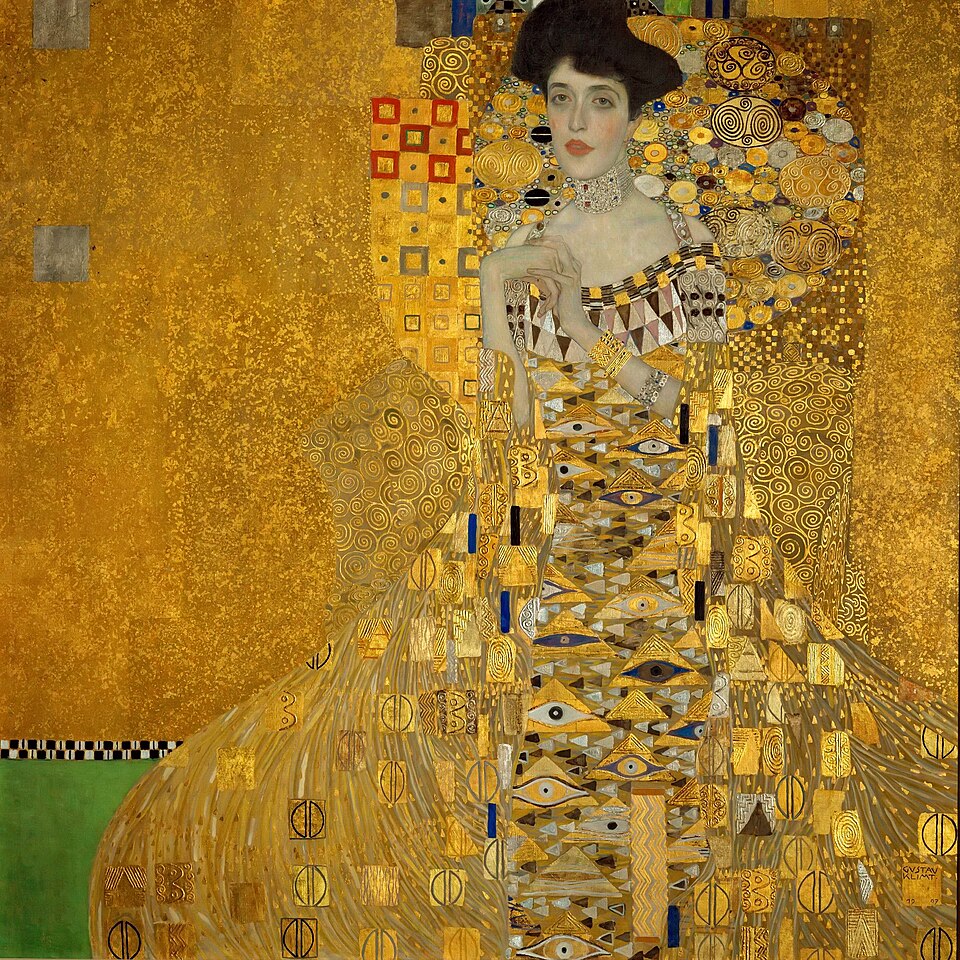
For the third time in this small series, I return to Gustav Klimt’s portrait of Adele Bloch-Bauer. It all began with the unusual position of her hands, something I had noticed several times before and for which I recently encountered a possible explanation in a video. Adele had a deformed finger, which Klimt concealed through the way her hands were clasped. In the first article, this story led me to questions about beauty, idealisation and individuality. In the second, I explored Klimt’s fascination with the Byzantine mosaics of Ravenna and the question of how something new can emerge from engagement with historical art. But a third question continued to occupy me: Who had actually decided that Adele should hold her hands in this particular way?
Was it Klimt who chose this pose for compositional reasons? Did Adele herself wish to conceal her finger? Had they arrived at a solution together? The Neue Galerie in New York reports that Adele was very conscious of her physical characteristic. We know nothing for certain, however, about the decision to adopt this particular pose. That is precisely what I find interesting. For behind the position of two hands lies a question that repeatedly concerns me in my own photographic work: Who actually determines how a person should be portrayed?
A portrait is, first of all, the work of an artist seeking to realise a particular vision. At the same time, it depicts a person who possesses an image of themselves. And finally, it is viewed by others who were neither involved in its creation nor necessarily acquainted with the person portrayed. These different perspectives can coexist in perfect harmony. But they can also diverge so dramatically that one begins to wonder whether everyone is even looking at the same picture.
Two People, One Image – Two Realities
In my photographic work, I sometimes find myself looking at an image after a shoot, convinced that it is among the best results of the day. The lighting is right, the composition has tension, the posture creates wonderful dynamism, and the expression conveys exactly the emotion I wanted to make visible. Perhaps something has come together in this single moment that could never have been entirely planned, despite careful preparation. To me, the photograph is almost perfect.
Then I show it to the model. And instead of the enthusiasm I had hoped for, I might hear: “Oh my God! Look what my breasts look like in this picture!” Or the objection concerns their backside, a thigh, a fold of skin on the stomach, or some other physical detail that I had not even noticed. While I perceive the overall composition, the other person’s attention seems to be concentrated on a tiny part of the image. What is entirely incidental to me can become the decisive criterion by which the model judges the entire photograph.
Now, it would be terribly convenient to conclude that, as the photographer, I simply recognise the artistic whole, whereas the model sees only their supposed physical shortcomings. Unfortunately, things are not quite that simple. My own perception is selective, too. I pay attention to the dynamism of the pose, the relationship between light and shadow, and the narrative impact of the image because I am pursuing particular artistic goals. In doing so, I may well overlook something of considerable importance to the person portrayed. My judgement does not automatically become more objective merely because I was the one who pressed the shutter release.
We are looking at the same photograph, but we are not necessarily seeing the same image. The photographer evaluates a representation according to an artistic intention, while the person depicted inevitably encounters themselves within it. And that encounter may evoke feelings quite different from those I intended to convey.
Why a Single Detail Can Preoccupy Us
Our self-image is not a neutral collection of physical characteristics. It develops through personal experiences, memories, social expectations, and the demands we place upon ourselves. We do not merely know what we look like. We also have ideas about what we would like to look like and which characteristics we would prefer not to reveal. A photograph can confirm these expectations, but it can also disturb them profoundly.
Psychology offers several possible explanations. One is selective attention. People do not look at an image by assigning equal importance to every detail. What concerns us personally often attracts our attention particularly strongly. Someone who is dissatisfied with a certain part of their body may notice it immediately in a photograph, while other viewers barely register it at all.
Another perspective is offered by psychologist E. Tory Higgins’s self-discrepancy theory. Among other things, it examines the differences between our actual self-concept and our ideas of how we would ideally like to be or believe we ought to be. When these ideas do not coincide, unpleasant feelings may arise. In a photograph, such discrepancies can sometimes become especially apparent. After all, it presents us with a concrete representation that does not necessarily correspond to the image we carry in our minds.
The halo effect is also interesting in this context. It describes how one prominent positive characteristic can influence our judgement of other characteristics. When it comes to a bodily feature perceived as undesirable, its negative counterpart may be more relevant: what is sometimes called the horn effect, in which one negatively evaluated detail affects the overall impression. Of course, we cannot conclude from someone’s dislike of a particular photograph that this mechanism is actually at work. But the idea is intriguing: a tiny part of an image may overshadow the entire artwork in a person’s perception.
We should, however, resist the temptation to explain every disliked portrait in psychological terms. Perhaps the photograph simply is not particularly good. Perhaps the photographer genuinely chose an unflattering perspective. And sometimes the model may have a better eye for a weakness the photographer has overlooked. Not every criticism of one’s own appearance is a perceptual error. But neither is every instance of personal dissatisfaction a well-founded judgement of an image’s artistic quality.
Self-Examination Begins Before the First Photograph
If I speak about subjective perception, I cannot confine my attention to the people in front of my camera. I must examine my own gaze as well. This begins with the selection of my models. I am a man and naturally have personal preferences regarding whom I find physically attractive. But those preferences must take a back seat in my artistic work. After all, I am not looking for someone who particularly appeals to me personally. I am looking for someone with the abilities required for a particular artistic concept.
In fact, some of my favourite models are almost the complete opposite of what I find physically attractive as a man. What fascinates me about them is something entirely different: their expressive power, their ability to convey emotions through their entire bodies, their sense of movement and tension, and their willingness to engage with unusual artistic ideas. Some people possess the remarkable ability not merely to understand a concept but to develop it further through posture, gesture and body language. They are much more than an attractive presence in front of the camera. They actively contribute to shaping the image.
The closest comparison is probably acting. When casting a role, the decisive factor is hardly whether the director personally finds the actor attractive. What matters is whether that person can portray the character convincingly. Of course, certain physical characteristics may be important for a particular role. But the real achievement lies in performance, expression and interpretation. A beautiful face alone does not make for convincing acting. And a particular bra size, with all due respect to the astonishing versatility of human anatomy, is simply no substitute for expressive ability.
Here, however, I must distinguish between two forms of my photographic work. In a personal portrait, I try to reveal something of the person’s essence: their personality, their peculiarities, perhaps their vulnerability, their strength, or those contradictions that make us interesting as human beings. One might say that I try to photograph something of their soul. Of course, that is not an objectively verifiable quality of an image. What I perceive in it always remains, to some extent, my interpretation.
In my independent artistic work under the name Artis Umbrae, the starting point is different. Here, the model’s actual personality is not necessarily the subject. I have an artistic concept, a story, a symbolic statement or an emotion that I want to make visible. The model takes on a role and contributes to its realisation through expressive ability. Someone can portray despair without being desperate themselves. They can embody strength even when they feel personally vulnerable. And they can portray a character whose qualities have almost nothing in common with their own personality.
An interesting counterpoint is provided by so-called Polas. These are photographs intended to show models as naturally as possible, originally taken with Polaroid cameras and now usually produced digitally. Without elaborate styling, generally without makeup, in neutral poses and under even lighting, they primarily document current physical appearance. Photographers, agencies and clients can use them to assess whether someone might be suitable for a particular assignment. One might say that the model presents themselves as a kind of canvas on which an image will later be created. Yet this canvas is by no means blank. The person already brings posture, personality and expressive potential. This particular form of photography therefore deserves an examination of its own.
We are dealing, then, with three different photographic tasks: What does this person look like? Who is this person? And what can this person portray? The answers need not coincide, and the quality of the respective images cannot be judged according to identical criteria.
“Feeling Brave Enough to Look Ugly Today?”
Sometimes an artistic concept requires a person not to appear beautiful in the conventional sense. Perhaps a character is meant to look exhausted, desperate, broken, angry or unattractive. Perhaps the image calls for a posture that is uncomfortable or far from flattering. What would be avoided in a conventional beauty portrait may be essential to the meaning of an artwork.
When I plan such a representation, I deliberately discuss it beforehand. Sometimes I ask the model quite directly: “Feeling brave enough to look ugly today?” Naturally, I do not mean that I consider the person ugly. I want to establish whether they are prepared to set aside the desire for a flattering portrayal in the service of an artistic idea. A model taking on a role in front of my camera does not necessarily have to look beautiful. Above all, the performance must be convincing and expressive.
With actors, we take this distinction for granted. Nobody would seriously demand that an actress portraying an exhausted, desperate or broken character should look as attractive as possible in every scene. A role may require someone to appear unattractive, unpleasant or even repellent. We judge the quality of the performance not by whether the actor conforms to our ideals of beauty, but by whether the character is convincingly portrayed.
Why should artistic photography be fundamentally different? It, too, involves representation. The model’s body is a means of expression, not necessarily an object to be judged for its beauty. A tense, contorted posture may be exactly right if it makes an inner conflict visible. A distorted facial expression may be more convincing than a harmonious smile. And a body shape that appears unusual in a particular photograph may contribute substantially to the image’s dynamism and impact.
Nevertheless, one difficulty remains: although the photographed model is playing a role, they still unmistakably see their own body in the finished image. Perhaps this causes their personal judgement of their appearance to become entangled with their assessment of a performance. This is a plausible consideration, not a universally established explanation. But it might help us understand why a model sometimes rejects an excellent portrayal even though it corresponds exactly to the artistic intention discussed beforehand.
Who Decides on the Final Image?
At this point, we must also consider the conditions of professional collaboration. When I engage a model for an independent artistic project, we discuss beforehand what photographs are to be made and what they are intended for. The model is paid for their participation. But the model is not my client, commissioning a portrait and then selecting the result according to their personal standards of beauty.
This is hardly unusual in a professional setting. When an advertising agency develops a campaign and hires a model, the services, working conditions and usage rights are agreed contractually. The people responsible for the project decide which photograph will ultimately be used. That does not automatically give the model an aesthetic veto. Otherwise, an advertising agency might have to redesign an entire campaign because the model disliked their left eyebrow in the selected photograph.
My independent artistic work operates along similar lines. I develop the concept, choose suitable models and take responsibility for its visual realisation. Artistic image selection is therefore part of my work. I remember an enquiry from a paid model who wanted to reserve the right to decide, after the shoot, which photographs I could publish. I declined to work under those conditions. Not because I fundamentally disregard a model’s wishes, but because such retrospective control over my artistic selection is incompatible with the way I work.
Naturally, that does not mean a model relinquishes all rights relating to their own person. Artistic freedom, agreed usage rights and personality rights are distinct matters. The boundaries of a collaboration must be clarified and respected. That is precisely why I discuss deliberately unflattering or drastic representations in advance. Once we have agreed on the artistic task and its conditions, however, the selection of suitable images should not subsequently depend on personal preferences about appearance.
When the President Dislikes His Portrait
A remarkable incident in the United States in March 2025 demonstrated just how far an artist’s intentions and the subject’s expectations can diverge. The artist Sarah A. Boardman had created an official portrait of Donald Trump for the Colorado State Capitol. The painting was unveiled in 2019 and hung in a gallery of presidential portraits for approximately six years. It had been financed through donations raised by Colorado Republicans.
Trump then publicly expressed his displeasure with the work. He described the portrait as deliberately distorted, declared that he would rather have no portrait at all, and personally criticised Boardman’s artistic abilities. Interestingly, he simultaneously praised her portrait of Barack Obama. Apparently, then, her abilities were not the problem in principle. At least not when it came to Obama.
The matter did not end with an aesthetic disagreement. Following Trump’s public criticism, the painting was removed from the Capitol and placed in storage. Boardman rejected the accusations. She stated that she had neither caricatured the president nor deliberately portrayed him unfavourably. The responsible commission had approved both the photographic reference and the progress of her work. She had fulfilled her commission as agreed. According to the artist, the public accusations had since had negative consequences for her business, which she had operated for more than four decades.
One does not need to like or dislike Trump to recognise the art-theoretical significance of this incident. Three different positions intersect here. An artist creates a portrait. A public body commissions and reviews the work. And the person portrayed declares, years later, that the result is unacceptable. Yet the subject’s personal preferences, the contractual fulfilment of a commission, and the artistic quality of the painting are by no means identical questions.
Of course Trump is entitled to dislike his portrait. He is also entitled to think it is bad. But that does not establish either that Boardman failed to fulfil her commission or that she deliberately distorted his appearance. Conversely, approval by a commission does not prove that the result is an artistic masterpiece. Artistic quality, after all, is not determined by majority vote. Fortunately, one might add. Art history would probably be considerably poorer if every work had first required the approval of everyone involved.
What makes this case particularly interesting is the connection between personal dissatisfaction and public power. The person portrayed was not a private client but someone with considerable political influence. His criticism had consequences for the work and its creator. This reveals a dimension of portraiture that extends beyond personal ideals of beauty: those who possess public influence may, under certain circumstances, also affect the visibility of an artwork.
Which brings us back to the question with particular clarity: Is a portrait a failure simply because the person depicted rejects it?
Must a Successful Portrait Please Its Subject?
I believe we must first distinguish between the purposes an image is intended to serve. In a personal portrait commission, the client’s satisfaction is naturally one of the essential criteria. If someone orders a portrait and cannot recognise themselves in it at all, I may have failed in my task, even if I consider the photograph artistically interesting. After all, a portrait commission is not a licence to replace the client’s wishes with my own ideas.
In independent artistic work, the priorities are different. A model may portray a role brilliantly without finding themselves personally attractive in the photograph. If the image conveys exactly the emotion, tension or statement I intended, it may be artistically successful even though the model is critical of their own appearance. An actress does not have to like the way her film character looks in order to have delivered an outstanding performance.
But here, too, it would be wrong to appoint myself the infallible judge of my own work. Perhaps I love a particular photograph because I know how difficult it was to create. Perhaps I remember an extraordinary moment during the shoot that is nowhere near as impressive in the finished image as I believe. Perhaps I am so delighted by a particular lighting effect that I overlook weaknesses in the composition. Photographers, too, can fall in love with their own pictures. And as with other forms of infatuation, critical distance is not necessarily the first thing that comes with it.
This matters to me particularly. I do not wish to set the model’s subjective self-perception against some supposedly objective artistic perception on the photographer’s part. We both bring our own experiences and expectations. The model knows their body and their personal history. I know the artistic concept, the creative process and the decisions behind the composition. Both influence our judgements. And both can occasionally obscure our view of the image’s actual effect.
Perhaps the real challenge, then, is to distinguish personal involvement from the impact of the finished image. I must ask myself whether my photograph genuinely communicates what I intended, or whether I merely know what it was supposed to communicate. The model can ask whether a personally disliked detail genuinely determines the effect of the entire photograph. And an uninvolved viewer brings yet another set of expectations and experiences. I have already explored at greater length in other articles of my Cogitationes why this perspective is not neutral either.
An artistically successful portrait and a portrait that satisfies the person depicted are therefore not necessarily the same thing. Sometimes the two judgements coincide. Sometimes they contradict each other. And sometimes that very contradiction reveals that we mean entirely different things when we speak of a successful image.
Returning to Adele
And so I return one final time to Gustav Klimt and Adele Bloch-Bauer. We do not know who suggested the unusual position of her hands. We do not know whether Adele was satisfied with the depiction or whether she would have preferred something different. Nor can we say with certainty what personal considerations occupied Klimt when making this decision.
What we see is the finished painting. We can examine its composition, identify its art-historical connections and admire the extraordinary combination of figure, ornament and material. We can explore Adele’s life and the circumstances in which the work was created. But we should not imagine that doing so grants us direct access to her personal feelings or to every intention Klimt may have had.
Perhaps this is a fundamental characteristic of every portrait. It shows a person, but never the whole person. It is always a selection, a composition, an interpretation. In a personal portrait, I may try to reveal something of a person’s essence. In an artistic staging, I may invite them to embody a role. In both cases, however, the result is not a complete representation of a person, but an image shaped by particular decisions.
And with that, the question of who owns the picture almost becomes secondary. Much can be settled in legal terms. But to whom does the meaning of a portrait belong? To the artist who created it? To the person depicted? Or to those who look at it and discover something that perhaps neither the artist nor the subject had consciously recognised?
Perhaps this is the most important insight to which the unusual position of Adele’s hands has led me: a portrait does not simply show what a person is like. It shows how that person was made visible at a particular moment, for a particular purpose, and through someone else’s eyes.
And sometimes, in the process, we learn at least as much about the person behind the camera as about the one in front of it.
Sources and Further Reading
- Gustav Klimt, Portrait of Adele Bloch-Bauer I (1907): Neue Galerie New York – Woman in Gold. On the unusual position of the hands and the painting.
- Gustav Klimt, Portrait of Adele Bloch-Bauer I: ALBERTINA – Catalogue and Preparatory Drawings.
- E. Tory Higgins (1987): Self-Discrepancy: A Theory Relating Self and Affect. Psychological Review, 94(3), 319–340. DOI: 10.1037/0033-295X.94.3.319.
- Richard E. Nisbett and Timothy D. Wilson (1977): The Halo Effect: Evidence for Unconscious Alteration of Judgments. Journal of Personality and Social Psychology, 35(4), 250–256. DOI: 10.1037/0022-3514.35.4.250.
- Sarah A. Boardman and Donald Trump’s portrait (2025): Colorado Public Radio, 7 April 2025.
- Background to the portrait commission: TIME – The Real Story Behind Colorado’s ‘Distorted’ Trump Portrait.
- The artist’s original statement: Colorado Times Recorder – Sarah Boardman’s Statement.