
The Seven Deadly Sins
Pride, greed, lust, envy, gluttony, wrath and acedia: for centuries, the seven deadly sins have been described, depicted and condemned as moral failings. Yet they are neither alien forces nor qualities found only in a few individuals. They emerge from human needs, desires and fears – and often contain something familiar from the very beginning.
Self-respect can become pride. The desire for security can become greed. Desire can turn into lust, comparison into envy, pleasure into excess, hurt into wrath, and exhaustion into inner withdrawal.
The boundaries are rarely clear.
In SEPTEM VITIA CAPITALIA, the deadly sins are therefore presented neither as a catalogue of religious morality nor as an accusation. The series regards them as forces at work within the human being: sometimes visible, sometimes hidden, sometimes controlled – and sometimes controlling.
The body becomes the place in which these inner movements take form.
Body, Expression and Shadow
The seven works deliberately dispense with props and traditional symbols. There is no mirror for pride, no gold for greed, no food for gluttony and no flames for wrath.
Each sin finds its expression through the body alone.
The poses are inspired by expressionist dance. Movement, tension, openness, twisting and withdrawal become vehicles for inner states. Some bodies rise or reach outwards. Others open, rebel, arch upwards or collapse inwards.
Light and shadow partially draw the body out of the darkness while allowing other areas to disappear within it. Shadow is not merely a consequence of the lighting. It extends the gesture, multiplies movement and makes visible what resists clear definition.
Nudity is neither decorative nor an eroticising addition. It reduces the representation to the human being. Clothing would indicate a particular time, social position or affiliation. The unclothed body carries nothing but posture, expression, light – and language.
Writing on the Body
Latin words are written on each body. They do not merely name the respective deadly sin; they give voice to its inner language:
I rule.
It is never enough.
I burn.
Why that other person?
I am still hungry.
I take revenge.
Nothing.
The words were written directly onto the body. The script used was a historical Bastarda – a form of writing whose animated, broken yet flowing lines enter into a visual relationship with the contours of the body.
The long and short s, the rounded r, ligatures and pronounced ascenders and descenders make the script less immediately legible to contemporary viewers. Movement, perspective and the shape of the body further stretch, curve and fragment the writing or partially conceal it.
This limited legibility is not a flaw. The writing does not serve solely to communicate language; it becomes a visual element in its own right. It follows the anatomy, changes with it and allows the body to appear as a living, inscribed surface.
For this reason, the words used in each work are reproduced in a modern typeface and translated in the accompanying descriptions.
SUPERBIA – Pride
Writing on the Body
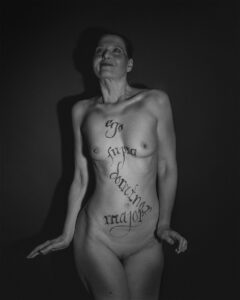
ego – I
supra – above, beyond
dominor – I rule
maior – greater, more important
The body rises and elevates itself above the surrounding space. The posture appears self-contained and self-assured; the gaze withdraws from the other. Pride is not expressed as loud arrogance, but as an inner certainty of one’s own greatness.
The words intensify from self-assertion to a claim of superiority:
I. Above. I rule. Greater.
AVARITIA – Greed
Writing on the Body
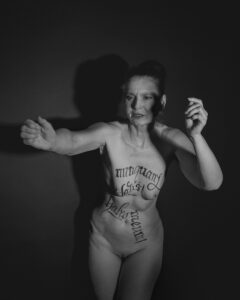
numquam satis – never enough
meum – mine, what belongs to me
habeo – I have, I possess
The body presses forwards. The hands reach, gather and seek to hold on. Yet possession brings no peace. What has already been acquired offers no sense of completion; instead, it creates the desire for more.
Meum and habeo express possession. Numquam satis reveals the inner mechanism behind it:
It is never enough.
LUXURIA – Lust
Writing on the Body
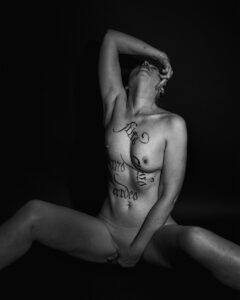
ardeo – I burn
sitio – I thirst
cupio – I desire
amo – I love
The body opens radically. The head falls back and the gaze withdraws, while the hands form a closed axis between the face and the lap.
The desire is not directed towards the viewer as an invitation. It remains within the body and belongs entirely to the person depicted. Desire appears as a state that takes hold of the whole human being:
I burn. I thirst. I desire. I love.
INVIDIA – Envy
Writing on the Body
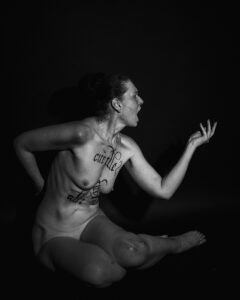
cur ille? – why that other person?
alter – the other
invideo – I envy
The body tenses towards an invisible counterpart. The open hand demands; the mouth appears to accuse. Envy becomes visible not merely as the desire to possess what belongs to another, but as the inability to endure another person’s precedence, happiness or success.
The decisive question is not:
Why do I not have it?
It is:
Why that other person?
GULA – Gluttony
Writing on the Body
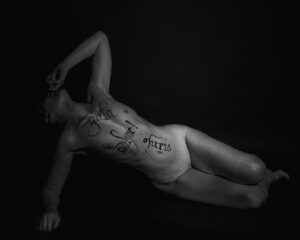
gula – gluttony; also throat or gullet
adhuc – still, yet, continuing
esurio – I am hungry
The body lies heavy and exhausted. The head falls back, one arm drops powerlessly to the floor – and yet one hand remains at the mouth.
Gluttony appears neither as joyful pleasure nor as visible abundance. It reveals the state that follows excess: satiety does not bring desire to an end. The body is exhausted, yet the inner voice continues to say:
I am still hungry.
IRA – Wrath
Writing on the Body
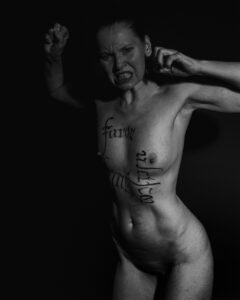
furor – fury, rage
ulciscor – I take revenge
ardeo – I burn
Wrath takes hold of the entire body. The face is tense, the teeth are bared, and the hands reach both outwards and towards the person’s own head.
The movement is directed against another – and at the same time against the self. Wrath becomes a force that attacks, distorts and tears apart the body’s inner order.
Here, too, the word ardeo appears:
I burn.
Yet the fire of desire has become a fire of destruction.
ACEDIA – Acedia
Writing on the Body
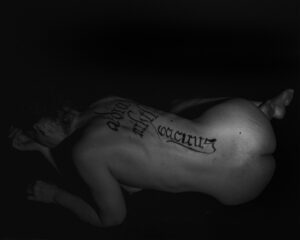
acedia – weariness, inner inertia, spiritual apathy
nihil – nothing
vacuus – empty
The body has withdrawn from the world. The face remains hidden, the arms form a barrier, and every movement appears to have come to a standstill.
Acedia means more than laziness. Historically, the term describes weariness, inner emptiness, indifference and the loss of the willingness to engage with the world.
The body is not resting. It has withdrawn.
Nothing. Empty.
The Seven Works
The seven photographs may initially be viewed without further explanation. The titles and their translations identify the respective deadly sins, while posture, expression, writing, light and shadow offer an individual path into the images.
Those wishing to explore the individual works in greater depth will find the expandable section “The Images, Words and Their Meaning” beneath the gallery. Clicking on it reveals descriptions of all seven photographs, together with transcriptions and translations of the Latin words written on the body.
This photographic series is part of CONVIVIUM and remains open to an independent culinary interpretation. It invites a chef to respond to the images through taste, aroma, texture and an artistic signature of their own.
Interested in a Collaboration?
CONVIVIUM is intended for chefs, restaurants, hotels, galleries and cultural venues that wish not merely to present photography and culinary art side by side, but to explore and develop them together.
Information on possible forms of collaboration, the presentation of the works and the joint development of a CONVIVIUM project can be found on the collaboration page.