
Anyone who knows me personally is aware of my deep passion for poetry. Words have accompanied me for many years – not merely as language, but as inner images, resonant spaces, and emotional landscapes. Among the poets who have stayed with me over time, Georg Trakl holds a very special place.
There are texts one simply reads. And then there are texts that carry us through certain phases of life because they suddenly find words for something that resists direct expression. In moments of particular emotional intensity, Trakl’s poetry was there for me – not as consolation in any simple sense, but as a counterpart, a condensation of darkness, memory, beauty, and pain.
Georg Trakl (1887–1914), an Austrian poet and one of the central voices of literary Expressionism, wrote in a language of extraordinary density. His poems are shaped by dream, night, decay, the body, and inner fracture. Within them, light and shadow, silence and abyss, beauty and disturbance coexist.
From this long-standing engagement emerged the series Corpus Scriptum – the inscribed body.
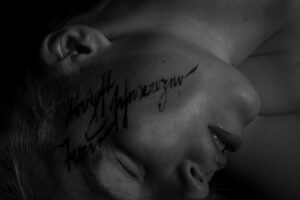
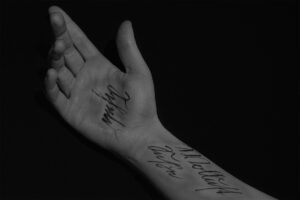
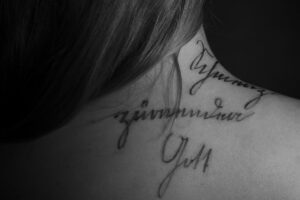
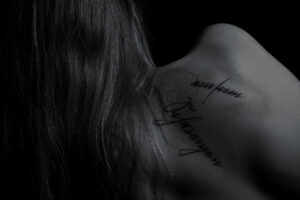
The words are not meant as mere illustration. Instead, selected fragments, condensed images, and fields of tension are extracted from the poems and written directly onto the skin. The body becomes a carrier of memory, emotion, and meaning; writing becomes trace, wound, thought, or dream.
A central element of the concept is the deliberate use of Kurrent script, a historic German cursive handwriting that was commonly used in Trakl’s lifetime. For an international audience, this script may be unfamiliar today. My decision to use it was never merely formal or nostalgic. It creates an immediate connection to the poet’s own historical moment and anchors the works within the linguistic and cultural world from which the texts emerged.
The script itself also carries its own history. Kurrent – together with its later educational form, Sütterlin – was largely removed from everyday use in the early 20th century and formally displaced from schools in 1941. Its disappearance from contemporary life makes it all the more significant to me. Within these images it returns like a trace from history, an echo of a vanished language inscribed into the living body.
It is precisely within this tension between historical handwriting and the contemporary body that the core of the series resides.
Each individual work is explained separately. In the expandable sections beneath the images, visitors will find the corresponding poems or letters, the selected word fragments, and a brief explanation of the conceptual background of each piece.

The poems and letters that form the basis of this series by Georg Trakl can be found easily in digital archives, literary portals, and public libraries. In order to keep the focus of this website on the photographic works themselves, the full texts are intentionally not reproduced here.
A companion catalogue for Corpus Scriptum is currently in preparation. It will include the complete poems, selected passages from letters, as well as extended essays and background notes on the individual works.
An important aspect of the series is the use of Kurrent, the historic German cursive handwriting commonly used in Trakl’s lifetime. As this script is largely unknown to an international audience today, the written words are transcribed below in modern Latin script.
Image I – Corpus Scriptum – Trakl I: To the Boy Elis
Poem / Source
Georg Trakl – To the Boy Elis (An den Knaben Elis)
Words written on the body
„tropft schwarzer Tau“
translation: black dew drips
Context
This work refers to one of Trakl’s most delicate and haunting poems. Elis appears as a fragile, almost otherworldly figure suspended between innocence, dream, and transience. The chosen words condense one of the poem’s most powerful images. The “black dew” is not a naturalistic detail, but a metaphor for melancholy, night, and the quiet intrusion of darkness into life.
Image II – Corpus Scriptum – Trakl II: Blood Guilt
Poem / Source
Georg Trakl – Blood Guilt (Blutschuld)
Words written on the body
„Wollust Süße“
translation: sweet lust
„Schuld“
translation: guilt
Context
Blood Guilt is among Trakl’s most intense and corporeal poems. It revolves around desire, inner fracture, and guilt. The selected words were chosen as opposing forces: “sweet lust” suggests seduction and sensuality, while “guilt” marks the inner abyss. The image translates this tension into the body itself.
Image III – Corpus Scriptum – Trakl III: Grodek
Poem / Source
Georg Trakl – Grodek
Words written on the body
„zürnender Gott“
translation: wrathful god
„Schmerz“
translation: pain
Context
Written under the immediate impression of the First World War, Grodek is one of Trakl’s final and most devastating poems. It binds human suffering to an almost apocalyptic metaphysical dimension. The selected words condense these two layers: individual pain and cosmic darkness.
Image IV – Corpus Scriptum – Trakl IV: In Winter
Poem / Source
Georg Trakl – In Winter (Im Winter)
Words written on the body
„einsam, Schweigen“
translation: solitary, silence
Context
This work translates Trakl’s winter imagery into a bodily landscape. The back becomes a silent nocturnal topography. Winter here stands for stillness, memory, and the peculiar coldness that runs through so many of his poems. The writing appears like a trace in snow.
Image V – Corpus Scriptum – Trakl V: Letter to Ludwig von Ficker
Source
Georg Trakl – correspondence with Ludwig von Ficker
Words written on the body
„jenseits der Welt“
translation: beyond the world
Context
This work is based not on a poem, but on Trakl’s correspondence with Ludwig von Ficker, his publisher, supporter, and one of the most important confidants in the final years of his life. These letters are crucial to understanding Trakl’s psychological and emotional state.
They reveal a sense of spiritual upheaval, estrangement, and existential isolation that also permeates his late poetry. The words “beyond the world” point to Trakl’s feeling of being detached from ordinary reality, suspended at the threshold between life, dream, and transcendence.